Charters, Settlement Rails and the Quiet Repricing of Trust
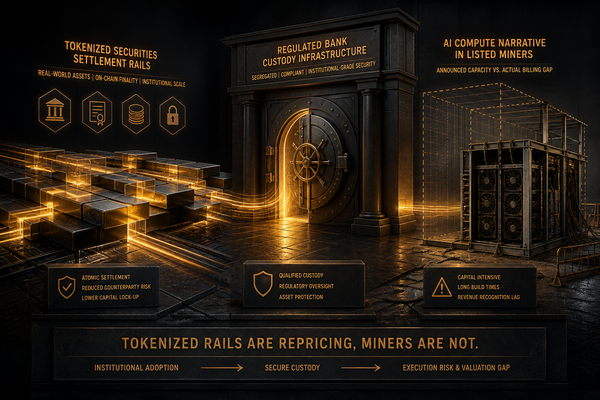
Tokenized deposits, federal bank charters and frontier cyber models converge on supervised trust as the scarce resource, re-intermediating institutional adoption through regulated venues.


Three threads this week point the same way: the binding constraint on institutional adoption is no longer throughput or capability, but legal finality, identity and custody. Tokenized deposits, federal bank charters and frontier cyber models are all converging on the same scarce resource, which is supervised trust.
The Signal
The week's most consequential moves were not product launches. They were jurisdictional: OpenReserve's preliminary OCC trust charter, DBS and Citi settling tokenized USD deposits across a weekend, South Korea's three-stage 2027 plan, and the Federal Reserve terminating enforcement actions against United Texas Bank and Quontic. Each converts a previously grey activity into a supervised one.
Running alongside, OpenAI's GPT-6 Astra hit "Critical" on its Preparedness Framework for cybersecurity and triggered a $1bn Daybreak commitment to defend essential services. That is the same pattern in a different domain: a capability so consequential that its distribution is being routed through state-adjacent channels rather than open markets.
The connective thesis is that trust is being re-intermediated. Not decentralised, not disintermediated. Re-intermediated into a smaller number of federally supervised, cryptographically verifiable, and increasingly consolidated venues.
Intelligence
Astra's substance is in the deltas, not the launch. Reaching Critical cybersecurity under OpenAI's own framework implies autonomous exploit discovery or novel attack synthesis beyond human red-team baselines. The $1bn Daybreak commitment then reads less as philanthropy than as controlled release of a dual-use capability into defensive hands, with utilities, hospitals and grid operators as the endpoints.
The Navier-Stokes result deserves more scepticism than it received. A "singularity find" across roughly 10,000 agents, 130bn tokens and more than $40m of inference in 88 hours is brute-force search with LLM-guided pruning. It is a credible computational lead, not a proof, and the Millennium Prize framing is doing reputational work the mathematics has not yet earned.
The genuinely interesting engineering signal is the pricing structure: 2.5x per token, but materially cheaper per task. That makes longer reasoning chains and agentic retries economically viable, which shifts the bottleneck from inference cost to orchestration and verification. The quiet red flag is "less monitorable". Interpretability is losing ground to capability precisely as deployment scales into SCADA-adjacent computer-use. Capability disclosure without monitorability is a regulatory liability dressed as an asset.
Elsewhere the intelligence signal was thinner and more honest about it. NVIDIA formalising Rust for GPU kernels is ecosystem positioning, not a capability jump; CUDA C++ and Python remain the enterprise toolchains and Rust will not mature until 2027 or later. BitRobot's 2,000 hours of open-sourced robot navigation data, sourced through Solana-based incentives, is a legitimate mechanism for acquiring scarce embodied data. The crypto layer is bookkeeping, not intelligence.
Infrastructure
The settlement layer is being rebuilt at the deposit and bond level, not the crypto-native level.
DBS and Citi's weekend USD tokenized-deposit settlement is the strategically largest item of the week. It attacks the correspondent-banking dead zone: SWIFT gpi remains batch-bound, Fedwire is closed at weekends. Tokenized deposits become a 24/7 complement to RTGS rather than a replacement, and both banks are deploying balance-sheet-adjacent infrastructure rather than vendor pilots.
On the issuance side, REC's ₹5bn ($59m) tokenized bond inside SEBI's sandbox upsized fivefold from ₹1bn after book building. That is the cleanest demand signal of the week, though still pilot-grade in scale. Hanwha's Avalanche build and South Korea's staged 2027 plan, with February-effective amendments, sequence settlement rails before asset issuance. That ordering is what makes the Korean timeline credible rather than aspirational.
The binding constraint is identity and privacy, not throughput. Matter Labs open-sourcing Prividium, with the Bundesbank as first deployer, is the tell: regulated institutions need permissioned, privacy-preserving state transitions with cryptographic verifiability, interoperable with legacy core banking. Whoever solves cross-chain institutional identity captures the routing layer.
Then there is the counter-example. Liquid's federation-coordinated halt after a $320m (roughly 3,998 BTC) unauthorised withdrawal, with exchanges suspending LBTC deposits, reveals the trust topology plainly. A fifteen-functionary federation is a permissioned bridge wearing a sidechain's clothes. That 3,400 BTC returned after a patch while 598.5 BTC (around $48m) remains missing is the load-bearing detail: recovery depended on negotiation, not cryptographic guarantee. The "white-hat" framing is unverified and sets a precedent that bridge exploits can be resolved socially, which weakens the case for immutable settlement rather than strengthening it.
Capital
Capital is rotating into wrappers and treasury vehicles, not spot.
Strategy's $176m STRC buyback, with zero BTC purchased, signals preferred equity trading below par. A position of roughly 4% of supply, worth about $66bn, is now managed for liability cost rather than accumulation. The marginal buyer has changed character. Capital B's $29m for 3,521 BTC, Strive's 1,375 BTC with 70% funded by SATA perpetuals, DeFi Development's $11m CHAD at a 13% dividend: this is expensive, retail-adjacent capital paying double-digit coupons to buy beta. That is a structurally weaker holder than 2024's convertible buyers.
ETF flow is real but rate-driven. A $731m single day, a $987m week, $3.52bn across August, the best since September 2025, attributed to Waller's dovish turn. This is macro-duration money and it will reverse on a hawkish repricing. Bitmine's 28,086 ETH takes it to 5.93m tokens, about 4.9% of supply, which is meaningful single-entity concentration in an asset whose float is supposed to be dispersed.
The charter race is a capital-structure play. OpenReserve's preliminary OCC approval, off a $25m seed from a16z, is the tell: a national bank charter is the cheapest permanent capital wrapper available, letting a firm hold customer fiat and settle onchain without state-by-state money transmitter drag. Block and Coinbase following confirms the thesis. SoFi and Payward is the more interesting structure, pairing an existing bank charter and deposit network with Kraken's exchange rails, effectively renting regulated balance sheet to a crypto venue.
The Fed terminating enforcement actions against United Texas Bank and Quontic is the enabling move. It reopens the correspondent banking channel that has been the binding constraint on fiat on and off ramps since 2023.
The Convergence
Read together, the three lenses describe one mechanism.
Frontier capability, whether agentic cyber defence or tokenized settlement, now requires a supervised wrapper to reach production. Astra's Critical rating routes it through Daybreak rather than the open market. Tokenized deposits route through DBS, Citi and eventually the Fed's rails rather than public chains. Crypto firms are buying charters rather than building parallel systems. Even the data layer is following: BitRobot uses Solana for attestation because it is cheap, not because it is trustless.
The consequence is consolidation. Charter holders gain a durable moat through deposit funding costs and Fed access; non-chartered venues face margin compression. Tokenized deposits disintermediate correspondent banks' weekend float revenue. Tether and Fasanara's $400m first close toward a $3bn stablecoin-denominated private credit fund shows stablecoin liquidity migrating into shadow banking, and the LP composition will determine whether that is genuine institutional allocation or captive capital.
The regulatory frame is now permissive by default in Korea, India and Singapore, with the United States catching up via supervisory normalisation rather than legislation. The risk is fragmentation into jurisdictional tokenized walled gardens if interoperability does not ship.
What Could Break the Thesis
- Pilot-to-production conversion. REC's bond upsized fivefold, but from ₹1bn. SEBI sandbox scale remains pilot-grade. Most tokenization announcements are not adoption.
- Weekend settlement cannibalising bank float. The revenue pool DBS and Citi are attacking is one their peers currently book. Incumbent resistance is rational and underweighted.
- Korea's 2027 timeline slipping. Three stages over two years is a long window for a regulatory programme with no precedent.
- Astra's monitoring gap. "Less monitorable" undermines the auditability that safety frameworks and government procurement both assume. Critical-tier cyber capability also invites pre-deployment regulatory friction.
- Daybreak as commitment, not revenue. Treat $1bn as pipeline until named agency contracts appear.
- Preferred-issuance stress. Thirteen per cent coupons against volatile collateral mark the late stage of the treasury trade. If ETF inflows reverse on a hawkish repricing, treasury vehicles are forced sellers into thin books.
- Bridge trust assumptions. Liquid's 598.5 BTC is a live loss until proven otherwise, and the social-recovery precedent is worse than the loss itself.
What to Watch Next
- Whether Daybreak converts into named agency contracts, which would validate sovereign-adjacent distribution as a durable revenue line for frontier labs.
- Whether OpenReserve's preliminary OCC approval becomes final, and whether Block's parallel bid follows. Charters are scarce and slow, which makes small approved banks acquisition targets.
- Whether the Fed's terminations extend to further institutions, reopening correspondent banking more broadly.
- SATA's billion-dollar milestone, and whether ETF inflows survive a hawkish repricing.
- Whether Prividium ships interoperability to legacy core banking, or remains a privacy layer without a routing story.
- And whether LBTC regains exchange acceptance, or whether the halt-risk premium becomes permanent. That single question will tell you more about institutional appetite for federated bridges than any pilot announced this week.