
free
Permission Is the New Scarcity: Regulated Rails Reprice Capital
MoonPay buys a broker-dealer, the SEC opens tokenised equities, Brazil closes a stablecoin corridor. The scarce asset is legal permission to move value, not compute or capital.

free
MoonPay buys a broker-dealer, the SEC opens tokenised equities, Brazil closes a stablecoin corridor. The scarce asset is legal permission to move value, not compute or capital.

free
Nasdaq's $100M mark on Payward, India's wholesale CBDC bond pilot, and Circle's validator set all point the same way: the securities and settlement layer is being rebuilt by regulated incumbents, while the AI compute trade runs on contracted capacity that has not yet been built or billed.

free
Tokenized deposits, federal bank charters and frontier cyber models converge on supervised trust as the scarce resource, re-intermediating institutional adoption through regulated venues.

free
Capital is shifting from technology to regulatory arbitrage. From Hyperliquid's US shelter to ICE's tokenization bet, the winners will treat compliance as a moat, not a cost.

free
Private networks are consolidating control of financial settlement, while regulatory fragmentation creates a two-tier market. The race to govern new rails—from stablecoins to tokenized collateral—will define the next decade of finance and AI.

free
Stripe's $7B OpenRouter purchase, Citi's custody entry, and Swift's tokenized deposits signal value shifting from asset creation to access, routing, and settlement layers.

free
Bitcoin is no longer just a store of value; it's becoming collateral for AI datacenter construction. As miners pledge BTC and institutions stake ETH, the crypto asset base is being repurposed as financing infrastructure, with regulated rails capturing the spread.

free
Institutional capital is consolidating toward regulated, yield-bearing tokenised instruments while speculative crypto products bleed, signalling a structural shift in trust architecture.
free
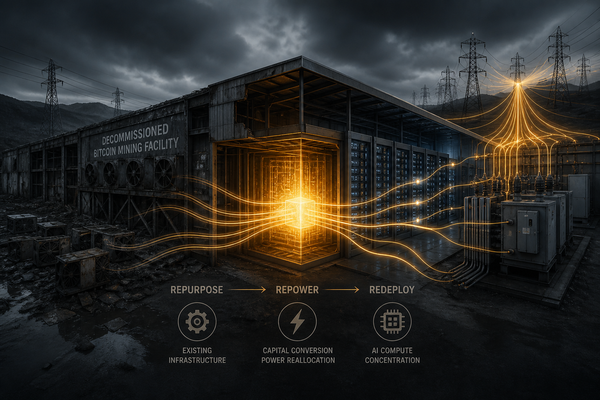
Capital is moving from building new capacity to converting existing physical and financial infrastructure. Every conversion creates a new chokepoint – and that concentration is the real risk surface.

free
Four major capital moves this week show investors betting on regulated stablecoin infrastructure—bank-grade rails, not retail hype—as the next phase of digital asset adoption.

free
Three signals this week—open-weight models crossing the frontier, tokenised securities plumbing, and stablecoin regulatory clarity—point to a shift from proprietary infrastructure to programmable, permissionless stacks.
free
Capital, Compute, and Settlement: The Three-Movement Convergence I watched three things happen this week. They looked separate. They are not. Capital is rotating out of passive bitcoin treasuries. It is moving into active AI infrastructure. The settlement layer for that deployment is being built with stablecoins, not speculative tokens. The