Stablecoin Banking’s Infrastructure Pivot Attracts $300M+ in Capital
Four major capital moves this week show investors betting on regulated stablecoin infrastructure—bank-grade rails, not retail hype—as the next phase of digital asset adoption.


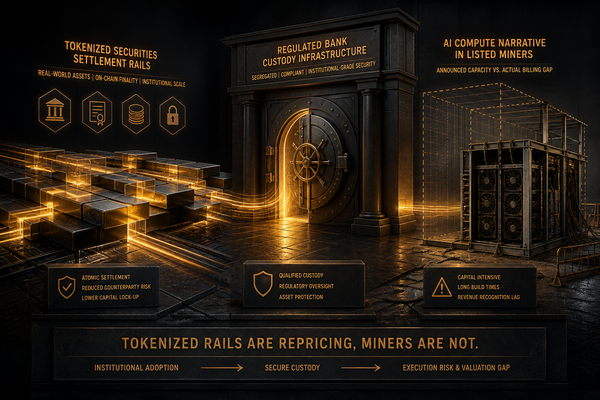
The week’s coordinated flow of capital into regulated stablecoin and tokenisation plumbing (Augustus with $180M, Alpaca with $135M equity plus $300M debt, Visa’s institutional stablecoin platform, and Robinhood’s Layer-2 chain) signals a deliberate shift from consumer speculation towards backend settlement infrastructure. The thesis is simple: the next phase of digital asset adoption will be driven by bank-grade rails, not retail hype, and investors are pricing a regulatory moat before revenue.
The Signal
When a single week produces a unicorn bank charter play, a broker custody expansion with BNP Paribas backing, a Visa network integration, and a retail broker launching its own chain, something structural is shifting. These are not isolated product launches. They form a coordinated build-out of what might be termed “plumbing-level” tokenised finance — infrastructure that sits beneath the user interface, wiring stablecoins into the core payment and securities settlement systems that run the global economy.
The signal is not new technology. It is institutional willingness to fund regulated, high-compliance infrastructure that bridges digital assets and traditional banking. The capital is coming from venture arms of existing financial giants (BNP Paribas, Visa), crossover funds (Tiger Global), and founders of successful fintech unicorns (Nubank, Ramp, Circle). This is not speculative gambling on token prices. It is a calculated bet on settlement finality, correspondent banking disintermediation, and the eventual migration of trillions of dollars onto programmable ledgers.
Intelligence
The technology across these four moves is mostly proven. None represents a breakthrough in AI or cryptographic capability. What is being built is integration logic and regulatory scaffolding.
Alpaca’s broker API allows fintechs to offer tokenised equities via SEC-registered custody. The backend runs on standard Kafka and Python stacks. The innovation is not algorithmic but procedural: enabling fractional settlement of stocks outside the Depository Trust Company’s legacy mainframe, using a combination of private ledger tracking and direct market access. BNP Paribas’s Opera Tech investment suggests the bank sees strategic value in offering tokenised securities to its corporate clients without building the rails itself.
Augustus’s Global Dollar Bank is the most technologically ambitious. It seeks a federal bank charter and a Federal Reserve master account, which would allow it to mint stablecoins directly on its own balance sheet and settle them across the Fedwire system. The core mechanism is replacing SWIFT’s multi-day correspondent chain with on-chain netting and same-day finality using USDC or its own bank-issued stablecoin. The technology is not novel — Circle already does this for USDC — but the regulatory wrapper is. A bank charter brings deposit insurance, supervisory oversight, and direct access to central bank reserves. That is the moat that justifies a $1B valuation on a company with minimal current revenue.
Visa’s Stablecoin Platform wraps existing ERC-20 mint/burn logic with KYC/AML middleware and connects it to Visa’s network of 15,000 financial institutions. Banks issuing OpenUSD (OUSD) through Visa can interoperate without building their own smart contract infrastructure. The intelligence here is network effect, not code: Visa’s existing relationships lower the adoption barrier to near zero for any bank wanting to offer stablecoin settlement to its corporate clients.
Robinhood’s Layer-2 chain is the weakest technology signal. Built on OP Stack or Arbitrum Orbit, it adds no unique capability beyond what Base or Polygon already provide. The motive is defensive: own the settlement layer for Robinhood’s existing 23 million funded accounts, preventing Coinbase’s Base from capturing that user base. Early on-chain activity is negligible. It is a real product but a tactical move, not a strategic shift.
Infrastructure
The infrastructure story is about layering — each announcement adds a new level of plumbing that connects digital assets to existing payment and securities rails.
Alpaca builds the custody and execution layer for tokenised equities. Its debt facility ($300M) suggests it expects to carry significant settlement inventory. This is not a technology bet; it is a balance-sheet bet on volume growth. The equity from BNP Paribas and Peak XV (formerly Sequoia India) validates the thesis that tokenised securities will eventually hold a meaningful share of global equity trading. The mechanism: an API that lets a neobank or investment app buy and settle fractional shares on a ledger rather than through DTC’s batch-processing cycle. Latency drops from T+2 to real-time. That is a genuine infrastructure improvement.
Augustus targets the settlement layer itself. By obtaining a Fed account and bank charter, it can offer stablecoin-based correspondent banking that bypasses the SWIFT network entirely. Today, a bank in Nigeria sending dollars to a bank in Mexico requires three intermediary banks, two days, and fees totalling 3–7%. With Augustus’s proposed system, the Nigerian bank mints USDC or a bank-issued stablecoin, sends it on-chain, and the Mexican bank redeems through its own Fed account within minutes. The cost drops to near zero. The challenge: obtaining the charter and convincing central banks to grant master accounts to a new entity. The $180M Series B is a bet that regulatory permission will come.
Visa’s Stablecoin Platform sits between issuers and the Visa network. It standardises the on- and off-ramp for bank-issued stablecoins, ensuring compliance while maintaining interoperability. Visa’s infrastructure advantage is its existing payment rails: it does not need to convince banks to adopt a new network, only to use Visa’s existing one for stablecoin settlement. The integration path is the lowest friction of any player.
Robinhood’s Layer-2 is the least infrastructurally significant. It provides a cheap settlement chain for Robinhood’s own products (crypto trading, payments, NFTs). But without external developer adoption or a token economics model, it remains a captive chain — useful for cost savings but irrelevant to the broader infrastructure game.
Capital
The capital flows this week reveal where investors see the highest returns.
Augustus’s $180M Series B at a $1B valuation implies investors are pricing a future monopoly or near-monopoly on regulated stablecoin banking. Tiger Global, as lead investor alongside Hummingbird and QED, is a crossover fund known for large, concentrated bets on platform businesses. The participation of founders from Nubank, Ramp, and Circle suggests a network effect thesis: these founders will bring their own payment flows to Augustus once the charter is live. The valuation is difficult to justify on current revenue but makes sense if one believes stablecoins will capture a significant share of global B2B payments within five years.
Alpaca’s $135M equity plus $300M debt is a more measured capital structure. The equity (Peak XV, BNP Paribas, and others) funds regulatory compliance and sales expansion. The debt (likely from private credit funds) funds the working capital needed to hold tokenised securities in custody. Price discipline on the debt is unclear, but the structure suggests Alpaca’s investors expect a path to profitability from lending and custody fees, not from token appreciation.
Visa’s stablecoin platform is not a capital raise but a product launch. However, the investment behind building the middleware (engineering, compliance, integration testing) is non-trivial and was funded from existing Visa R&D budgets. The return for Visa is increased transaction volume on its network as banks issue stablecoins and settle through Visa.
Robinhood’s L2 chain required modest engineering spend relative to its $4.8B market cap. It is a defensive capital allocation, not a growth investment. The chain’s success will be measured by whether it retains Robinhood users who might otherwise leave for self-custody on Base or Arbitrum.
The Convergence
The convergence across these four threads is the thesis that stablecoins are becoming the settlement layer for both payments and securities, and that this shift requires regulated, bank-grade infrastructure to scale beyond retail speculation.
Augustus provides the bank charter and Fed access. Alpaca provides the securities custody and trading API. Visa provides the network connectivity and standardisation. Robinhood provides the retail-facing chain. Each fills a gap that the others cannot easily fill. Together, they form the scaffolding for a financial system where tokenised dollars and equities move across ledgers and bank accounts interchangeably.
The actual convergence mechanism is the stablecoin itself. Augustus will issue or support bank-backed stablecoins. Visa will enable those stablecoins to be minted and redeemed by its bank network. Alpaca will settle tokenised equity trades in those same stablecoins. Robinhood’s chain will let retail users hold and transact those stablecoins on a low-fee L2. The implication: within two to three years, a user could sell a tokenised Apple share on Alpaca’s rail, receive USDC or a bank stablecoin, settle through Augustus’s charter in minutes, and spend that stablecoin via a Visa card — all without touching a traditional bank account or SWIFT wire.
That is the convergence. It is not here yet. But the capital deployed this week suggests investors believe it is coming.
What Could Break the Thesis
Regulatory denial. Augustus’s entire valuation rests on obtaining a federal bank charter and Fed master account. The OCC and Federal Reserve have been cautious about granting new charters to crypto-native entities. Previous attempts (like Anchorage’s national trust charter) have not scaled to full bank status. If Augustus is denied or delayed significantly, the $1B valuation will look exposed.
Adoption inertia. Visa’s stablecoin platform requires banks to issue stablecoins. Most banks are still risk-averse on digital assets. Without at least one top-20 US bank issuing OUSD, the platform remains a boutique service. B2B payment flows are notoriously sticky; SWIFT will not disappear quickly.
Competition from existing stablecoins. USDC and USDT already have liquidity and network effects. Augustus’s bank-issued stablecoin would need to offer better regulatory assurance (deposit insurance, Fed access) to lure users away. That is plausible but not guaranteed.
Overcapitalisation. Alpaca’s $300M debt facility is a leveraged bet on trading volumes. If tokenised equity trading fails to gain traction — if retail users stick with traditional brokers — Alpaca may struggle to service that debt. The equity cushion ($135M) helps, but the structure is more aggressive than it appears.
Robinhood’s L2 irrelevance. If developers ignore Robinhood’s chain, it will remain a ghost chain serving only Robinhood’s own apps. That is not a disaster (it still reduces transaction costs) but it eliminates any network-effect upside.
What to Watch Next
- Augustus’s charter application timeline. Watch for public filing with the OCC or an announcement of a conditional approval. If they receive a preliminary nod within six months, the thesis strengthens significantly.
- Visa’s first bank issuer. If a top-20 US bank or a major international bank (HSBC, Santander) announces it will issue OUSD through Visa’s platform, adoption acceleration is underway.
- Alpaca’s debt terms. The spread on the $300M debt facility is not public. A high yield would indicate lenders see real default risk. If the debt is below 8%, it signals confidence.
- Robinhood’s developer grants. If Robinhood announces a real developer incentive program or airdrop for its L2, it signals they are serious about external adoption. If silence persists, the chain is purely defensive.
- Regulatory statements on stablecoin banking. Any speech or guidance from the Fed or OCC that explicitly supports or discourages stablecoin issuance by banks will move all four thesis components.
The infrastructure is being laid. The question now is whether the capital will attract the users, or whether the users will force the capital. Either way, the direction is clear: tokenised finance is moving from the fringes to the backbone.