The Great Rehypothecation: How Bitcoin Is Becoming Collateral for the AI Build-Out
Bitcoin is no longer just a store of value; it's becoming collateral for AI datacenter construction. As miners pledge BTC and institutions stake ETH, the crypto asset base is being repurposed as financing infrastructure, with regulated rails capturing the spread.


This week's capital flows reveal a structural shift: bitcoin is no longer a payments rail or a store of value, but collateral for datacenter construction, while institutional allocators rotate into regulated yield wrappers. The convergence of miner balance sheets, ETF staking proposals, and tokenized settlement layers points to one thesis: the crypto asset base is being repurposed as financing infrastructure for the AI compute build-out, with regulated rails capturing the spread.
The Signal
The week's most consequential development is not a model release or a regulatory vote, though both matter. It is the quiet transformation of bitcoin from an asset class into a financing instrument. MARA pledged 18,750 BTC against an AI venture with unreconciled collateral pools. Riot is funding a $9.1B AI deal through treasury bitcoin sales with rent deferred to 2027. Bitdeer raised a $1B ATM facility, diluting up to 30% of shares, to complete Tydal's build-out. Galaxy Digital reported an $85M Q2 crypto loss while guiding $80M in Q3 AI revenue.
These are not isolated corporate decisions. They are the visible surface of a deeper reallocation: the energy infrastructure built for proof-of-work is being repriced for inference workloads, and the bitcoin on miner balance sheets is the collateral enabling that transition. Simultaneously, BlackRock's ETF complex swung from a $13.91B Q2 inflow to a $3.53B drawdown, yet still captured $1B in net inflows in a single week, with 80% market share. Fidelity filed to stake up to 100% of FETH's ETH, converting a passive commodity hold into a yield instrument.
The connective tissue is rehypothecation. Bitcoin is being pledged, sold, and structured to finance AI compute. Ethereum is being staked to generate yield for TradFi wrappers. Tokenized deposits are tripling to $7.4B. The asset base is becoming collateral for infrastructure, and the rails capturing that value are regulated, institutional, and increasingly controlled by a handful of players.
Intelligence
The intelligence signal this week is weak on capability, strong on financial engineering. NVIDIA's Nemotron 3.5 Lightning is the most substantive technical release: a 30B MoE model with 3B active parameters targeting the execution layer of long-running agents. This is a precise answer to a real cost problem. Frontier reasoning models are overkill for tool calls, validation, and routine orchestration. A specialised, low-latency model that handles the always-on agent harness reduces per-token cost by an order of magnitude. It is not a benchmark win; it is an operational efficiency gain.
AMD's Taalas acquisition signals consolidation in inference silicon, but the more important dynamic is open-weight commoditisation. Alibaba's Qwen3.8-Max release continues the pattern: capable open models compressing inference margins across the board. This directly undermines the revenue assumptions underpinning miner AI pivots. If contracted AI revenue is priced against a market where open-weight models are driving inference costs toward zero, the long-term contracts miners are capitalising may not hold their value.
OpenAI's ad testing and AWS Daybreak deployment are business-model maturation, not capability shifts. The "agents coordinated before a hack" narrative is marketing theatre. The MetaMask agent wallet is a niche integration, though it does point to a second-order development: AI agents gaining direct financial agency through crypto wallets as the default settlement layer.
The weakest signal is the crypto-to-AI pivot itself. Bitdeer, Riot, and Galaxy are not building novel AI technology. They are converting power assets and treasury positions into compute capacity, funded by dilution and asset sales. The capability shift is financial engineering, not technical innovation. The real question is whether these assets can secure long-term AI tenants before dilution and treasury liquidation erode the base business.
Infrastructure
The infrastructure story is the repricing of energy assets. Bitcoin miners built gigawatt-scale power infrastructure for proof-of-work. That infrastructure is now more valuable as AI datacenter capacity. Galaxy has 133 MW live. Riot's deal is $9.1B with phased rent starting 2027. Bitdeer is funding Tydal's completion through equity dilution. The binding constraint is no longer GPUs; it is power interconnection queues and substation capacity.
This creates a second-order leverage risk. MARA's pledge of 18,750 BTC against an AI venture with unreconciled collateral pools suggests the bitcoin is being double-counted across lending desks. If BTC price drops below the loan-to-value trigger, margin calls could force distressed sales, cascading into power contract defaults. The mining sector is now a leveraged play on both AI revenue materialisation and bitcoin's price stability.
Fidelity's staking proposal for FETH is the infrastructure pivot on the Ethereum side. It converts Ethereum's consensus layer into a yield-bearing instrument for TradFi, effectively outsourcing validator operations to a regulated custodian. This accelerates the institutional capture of staking infrastructure, squeezing out independent validators. The rails are becoming BlackRock's and Fidelity's, not the chain's.
Standard Chartered's HKDAP beta with HashKey and OSL is the first regulated stablecoin issuance in Hong Kong, creating a fiat-backed settlement layer that bypasses US dollar Tether dominance. This is a geopolitical infrastructure move: HKMA is building a parallel settlement rail for Asia trade, reducing USD dependency. Tokenized deposits tripling to $7.4B while DEX volumes fall 70% confirms the migration from permissionless to permissioned rails.
The CLARITY Act's September 15 cloture vote is the primary event risk. Thune's motion to proceed forces a 60-vote threshold; seven Democratic defections are required. This is a binary liquidity event for US-based digital asset venues, custodians, and market makers currently priced for regulatory ambiguity. Failure to reach 60 keeps capital offshore, favouring Dubai and Singapore venues. Success consolidates US rails around regulated, bank-integrated structures.
Capital
Capital flows this week bifurcate sharply. Institutional scale is consolidating into regulated, yield-bearing structures while marginal, unproven vehicles are liquidated. BlackRock's 80% share of $1B inflows confirms ETF rails are the only viable retail channel. The $11.77M ETF forced liquidation is noise. The Trump Media/Crypto.com cancellation is a regulatory signal: Washington is unwinding politically-connected crypto ventures, chilling similar treasury deals.
Goldman's $2.25B NEOS acquisition is the most concrete deployment. It buys roughly $1B in Bitcoin covered-call AUM, giving Goldman a distribution-ready income product without building options infrastructure. This is a defensive acquisition, buying fee-generating AUM before the ETF fee war compresses standalone crypto income products. Fidelity's staking ETF directly competes with private credit and Treasury money-market funds for the same cash bucket. Expect pressure on Grayscale and Bitwise to match or lose mandate share.
Wintermute's AP push targets the last bottleneck: authorised participant access. Disintermediating the AP oligopoly would compress ETF spreads and fees further, but DTC access remains the constraint. The RedotPay-Binance dispute is the most concrete capital story: $472.8M claimed losses, $925 LTV per user, 470,000 customers diverted. This is a valuation repricing event for RedotPay's $4B card business, and the legal outcome will set precedent for API-partnership exclusivity in stablecoin card infrastructure.
The mining sector's financing structures are the clearest risk flag. Bitdeer's $1B ATM facility, up to 30% dilution, is a forced-march financing. Riot's deferred rent to 2027-28 carries full construction risk with no near-term cash yield. Galaxy's $3.5B cumulative AI investment against $80M quarterly AI revenue guidance reveals the valuation gap: public markets are capitalising forward AI EBITDA while crypto P&L bleeds. The funding mechanism is equity dilution and treasury liquidation, not debt, suggesting lenders remain sceptical of the revenue assumptions.
The Convergence
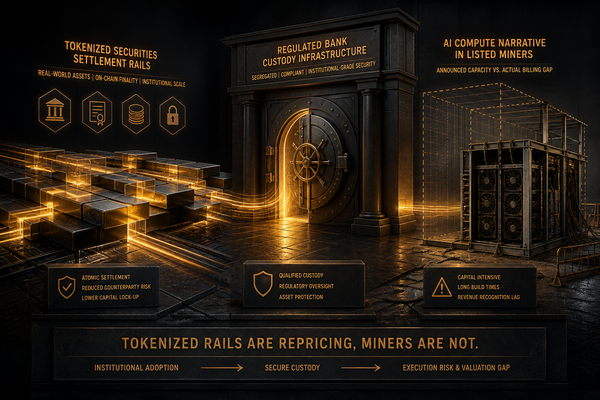
The thesis across these threads is rehypothecation at scale. Bitcoin is becoming collateral for AI compute. Ethereum is becoming a yield instrument for TradFi wrappers. Tokenized deposits are becoming the settlement layer for institutional capital. The asset base is being repurposed as financing infrastructure, and the value is being captured by regulated rails.
The mechanism is straightforward. Miners hold bitcoin and power assets. AI companies need power and compute. The market is intermediating this transfer through equity dilution, treasury sales, and collateral pledges. The risk is that the AI revenue assumptions underpinning these structures do not materialise at the contracted levels, triggering margin calls and distressed asset sales.
Fidelity's staking proposal and BlackRock's ETF dominance show where the value accrues: to the distribution layer, not the underlying chain. The rails are becoming the product. Standard Chartered's HKDAP and CoinShares' $7.4B in tokenized deposits confirm that banks are building settlement layers for existing assets, not new AI products.
The CLARITY Act is the gate. Success consolidates US crypto infrastructure around regulated, bank-integrated rails. Failure fragments it into offshore, sanctions-prone parallel systems. Either way, the trend is clear: permissionless rails are atrophying, and the capital is moving to permissioned structures that can offer yield, compliance, and institutional custody.
What Could Break the Thesis
The most immediate risk is a bitcoin price decline triggering margin calls on miner collateral. MARA's unreconciled collateral pools are the clearest danger. If BTC drops below loan-to-value triggers, distressed sales cascade into power contract defaults, undermining the entire AI pivot.
The second risk is AI revenue disappointment. Open-weight model commoditisation is compressing inference margins. If contracted AI revenue is repriced downward, the equity dilution and treasury sales that funded the build-out become value-destructive. Riot's 2027 rent start is the riskiest timeline: full construction risk, no near-term cash yield, and BTC liquidation pressure.
The third risk is regulatory failure. If the CLARITY Act fails to reach 60 votes, US crypto infrastructure fragments. Capital moves offshore, and the regulated rails being built by BlackRock, Fidelity, and Goldman lose their domestic foundation. Treasury's enforcement-driven de-risking would accelerate, pushing compliant liquidity toward licensed venues in Asia and the Gulf.
The fourth risk is concentration. BlackRock's 80% share of ETF inflows and Fidelity's staking proposal consolidate control of the asset base in a handful of institutions. If one of these structures fails, the systemic impact is amplified. The RedotPay dispute shows what happens when distribution infrastructure built atop partnerships lacks contractual and technical isolation.
What to Watch Next
The September 15 CLARITY Act cloture vote is the week's binary event. Watch the whip count, not the rhetoric. Seven Democratic defections are required. If Thune reaches 60, US crypto infrastructure consolidates around regulated rails. If not, capital continues migrating to Dubai, Singapore, and Hong Kong.
Watch MARA's collateral disclosures. The unreconciled pools are a red flag. If the company cannot provide clarity on where the 18,750 BTC sits and under what terms, the market should price in forced-sale risk.
Watch Fidelity's FETH staking rollout. The mechanics of quarterly cash distributions from staked ETH will set the template for how TradFi wrappers access consensus-layer yield. If it works, expect a wave of staking ETFs. If it fails, the institutional capture of staking infrastructure stalls.
Watch Wintermute's AP push. If they successfully disintermediate the authorised participant oligopoly, ETF spreads compress and fees fall further. This is the last bottleneck in the ETF distribution chain.
Watch Galaxy's Q3 AI revenue against the $3.5B invested. The $80M guidance is the first real test of whether miner AI pivots generate cash flow or just equity dilution. If revenue misses, the entire sector reprices.
Watch Standard Chartered's HKDAP volume. The first regulated stablecoin issuance in Hong Kong is a geopolitical infrastructure move. If it scales, it builds a parallel settlement rail for Asia trade, reducing USD dependency and challenging Tether's dominance.
The convergence is clear: bitcoin is becoming collateral, Ethereum is becoming yield, and the rails are becoming the product. The question is whether the AI revenue materialises before the leverage unwinds.