When Commodity AI Meets Programmable Capital
Three signals this week—open-weight models crossing the frontier, tokenised securities plumbing, and stablecoin regulatory clarity—point to a shift from proprietary infrastructure to programmable, permissionless stacks.

This week produced three structurally linked signals: open-weight models crossed the frontier, capital markets began building the plumbing for tokenised securities, and stablecoins gained regulatory clarity as a settlement layer. Together, they suggest a shift from proprietary, rent-extracting infrastructure to programmable, permissionless stacks in both AI and finance, with material implications for how allocators think about moats and value accrual.
The Signal
Three developments, each independently significant, form a coherent picture when read together. Moonshot AI released Kimi K3, a 2.8-trillion-parameter open-weight model that matches or beats GPT-5.6 and Claude Fable on creative tasks and frontend coding at Sonnet pricing. In capital markets, Citadel Securities placed $600 million into Kraken and Crypto.com to secure market-making capacity for the DTCC's tokenised securities pilot, while Alpaca raised $435 million to build custody rails for tokenised equities. On the regulatory front, Visa launched its Stablecoin Platform for bank issuance, the UK deferred capital gains tax on DeFi lending, and Bolivia moved to recognise USDT as legal tender. The common thread is a migration from closed, centrally governed systems — whether in AI inference or financial settlement — toward open, composable layers where value accrues to the infrastructure provider, not the gatekeeper.
Intelligence
The open-weight arrival is no longer a warning; it is here. Kimi K3's 2.8T-parameter mixture-of-experts architecture with 50B active parameters per token operates at a cost comparable to Anthropic's Sonnet class, yet delivers performance that tests above both Sonnet and GPT-5.6 on established benchmarks for creative writing and front-end code generation. The immediate capital-markets reaction — a selloff in semiconductor stocks — was a rational repricing of the assumption that proprietary frontier models would sustain infinite compute demand. If anyone can run near-frontier inference on their own hardware, the margin compression for API-based inference is acute.
Inkling, Mira Murati's first post-OpenAI release, adds a Western open-weight option at 975B parameters (41B active). It does not lead the global leaderboard — both Kimi K3 and DeepSeek's latest outrank it — but it plugs a specific gap: an Apache 2.0 licensed model from a trusted American entity that domestic enterprises can deploy without geopolitical friction. The open-weights ecosystem is now effectively bifurcated by jurisdiction, with Chinese models leading on raw capability and Western models leading on licensing and trust.
OpenAI's GPT-Red, a dedicated automated red-teaming model, signals that safety infrastructure is also moving from manual, post-hoc reviews to continuous, model-in-the-loop testing. Cars24's deployment of 1 million voice-agent minutes per month demonstrates that agentic voice workflows have crossed from demo to production scale on these API rails. Meanwhile, Codex reached 7 million users with a 1 million net addition in a single day — silent acceleration of developer tooling that runs on the same inference layer under pressure from open alternatives.
The capability shift is concrete. A 2.8T open model that matches closed frontier performance at a fraction of the API cost compresses margins for every inference provider without a proprietary data or distribution advantage. It also reopens the question of whether training compute demand will continue to grow exponentially or plateau as open models absorb the market.
Infrastructure
The week's infrastructure signals are dominated by two unrelated but consequential vectors: stablecoin payment rails hardening into mainstream finance, and a breakthrough in quantum error correction that begins to calendar the post-quantum threat.
Visa's Stablecoin Platform directly competes with Stripe's crypto push by allowing banks to mint and transfer tokenised deposits (starting with USDC) over the existing Visa network. This is not permissionless cryptocurrency; it is institutional on-chain settlement using bank-issued tokens that settle over Visa's rails. The UK's decision to defer capital gains tax on DeFi staking and liquidity pools removes a major friction for institutional participation. Bolivia's move to legalise USDT as a payment method, using TRON and Ethereum, dollarises local payments through a non-sovereign settlement layer. New Hampshire's 'Blockchain Basic Laws' codify miner and staker protections, creating a US state-level safe harbour that could host node infrastructure for tokenised markets. The Clarity Act debate over stablecoin reward language, still contested by the banking lobby, is the remaining regulatory fault line.
Taken together, these moves create a legally legible, tax-efficient, network-integrated environment for tokenised assets to settle. They are the precondition that makes Citadel's $600 million exchange investment and Alpaca's $435 million custody raise rational — not speculative.
On the longer horizon, NVIDIA's Ising decoding for colour codes reduces logical error rates by 300x, bringing fault-tolerant quantum computing measurably closer. The second-order implication for financial infrastructure is that lattice-based cryptography (ML-KEM, ML-DSA) now has a credible deployment deadline. Every tokenisation platform, stablecoin issuer, and exchange that uses elliptic-curve cryptography will eventually need to migrate. The timeline is still measured in years, but the physics is no longer theoretical.
Capital
The capital flows this week are concentrated in three deployment vectors, all pointing toward the same end state: tokenised securities requiring 24/7 on-chain market-making and custody.
Citadel Securities' $400 million stake in Crypto.com at a $20 billion valuation and $200 million into Kraken are not bets on retail speculation. They are strategic pre-positioning for the DTCC tokenisation pilot involving BlackRock, Goldman Sachs, and JPMorgan. These exchanges will be the venues where tokenised stocks and treasuries trade continuously, and Citadel is buying the right to provide baseline liquidity. The risk is that retail flow dries up in a macro selloff, leaving these exchanges unprofitable on a GAAP basis, but the entry logic is clear: own the venue before the institutional volume arrives.
Alpaca's $135 million equity raise led by Peak XV (Sequoia India) alongside $300 million in debt is structured to expand balance sheet capacity for settlement guarantees. The counterparty includes BNP Paribas via Opera Tech, a direct signal that European banking views tokenised equity custody as a real, near-term business. Alpaca is building the API bridge between legacy broker-dealer infrastructure and on-chain settlement.
T. Rowe Price's TKNZ spot ETP, with $1.89 trillion in assets under management primarily from retirement and institutional clients, is a conviction bet that the SEC will approve diversified crypto products as the market matures. The product structure — a single-asset basket rather than the multi-token baskets investors previously rejected — suggests T. Rowe expects granular institutional demand. If the 401(k) channel opens, the AUM bleed risk in early months is tolerable.
The weak signal is Tether's $20 billion gold lending plan, which lacks concrete borrowers or terms. It represents a possible expansion of parallel banking, but without counterparty details it remains a surveillance item. The FTX $900 million distribution provides modest buy-side pressure, offset by distressed creditor selling.
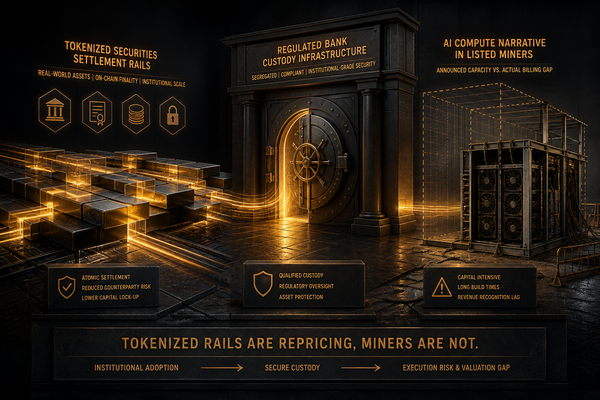
CleanSpark's $6.6 billion AI lease on 175 MW is a pivot from Bitcoin mining to high-performance compute hosting, but the deal's $2.1 billion construction funding gap renders it contingent. If compute demand softens, the milestone-based rent penalties create stranded asset risk.
The Convergence
The three threads meet at a specific intersection: cheap frontier intelligence as an enabler for tokenised capital markets.
Kimi K3 and Inkling make it possible to run sophisticated risk models, fraud detection, and market-making algorithms on the same infrastructure that settles tokenised assets. A developer can now deploy a commodity AI model to predict liquidity gaps in a 24/7 treasury market, and settle the resulting trades over stablecoin rails that bypass correspondent banking. The cost of intelligence is falling toward zero relative to the value of the flows it manages.
The capital flows this week are funding the venues (Kraken, Crypto.com), the middleware (Alpaca), and the distribution (T. Rowe Price) that together form the stack. The infrastructure developments — Visa's stablecoin platform, UK tax clarity, New Hampshire safe harbour — provide the regulatory and settlement foundation. The intelligence developments provide the processing layer that makes these markets efficient.
What emerges is a system where value accrues to the protocol layer (settlement rails, exchange networks, open models) rather than to proprietary gatekeepers. That is the structural shift allocators must calibrate against: the moat is no longer exclusivity of access, but reliability and liquidity at scale.
What Could Break the Thesis
Three risks are material.
Regulatory reversal remains the clearest. If the SEC or Fed reclassifies stablecoins as securities or restricts bank participation in tokenised settlement, the infrastructure build-out loses its base case. The Clarity Act debate over reward language and the banking lobby's ongoing resistance to stablecoin yield are early warning signs.
Macro tightening could choke the retail flow that currently supports exchange valuations. If Citadel's Kraken and Crypto.com stakes are predicated on sustained volume and that volume evaporates in a risk-off environment, the expected liquidity provision for DTCC may not materialise on schedule.
Quantum cryptography is a longer-term but existential threat to the cryptographic underpinnings of both tokenised assets and AI model integrity. NVIDIA's Ising decoding accelerates the timeline; if a fault-tolerant quantum computer capable of factoring 2048-bit RSA arrives inside a decade, every system that relies on today's elliptic-curve signatures will need a coordinated migration. That is a coordination problem that financial infrastructure has never solved.
What to Watch Next
Three catalysts will test the thesis in the coming weeks.
The DTCC tokenisation pilot's initial trading data, due within the next reporting cycle, will reveal whether institutional volumes are actually shifting on-chain or remaining notional. Any sign that market-making depth is insufficient will pressure exchange valuations.
Moonshot AI's next release and the pricing trajectory of Kimi K3 inference will show whether the open-weight cost advantage holds or erodes as closed models cut prices. If GPT-6 or Gemini 3 is released at a lower per-token cost than Kimi K3, the commoditisation thesis for AI reverses.
The final language of the Clarity Act's stablecoin provision, expected before the end of the quarter, will determine whether institutional DeFi participation expands with tax clarity or contracts under regulatory uncertainty.
Until those data points arrive, the directional bet is that open models and programmable money are converging toward a cheaper, faster, flatter financial system, and that capital is rightly building the plumbing. The risk is that the plumbing gets built before the water flows.