The New Arbitrage: When Market Structure Becomes the Product
Capital is shifting from technology to regulatory arbitrage. From Hyperliquid's US shelter to ICE's tokenization bet, the winners will treat compliance as a moat, not a cost.


This week's signals converge on a single thesis: the most valuable infrastructure being built is no longer technological but jurisdictional. From Hyperliquid seeking US regulatory shelter through Kraken's parent to ICE embedding tZERO into its settlement stack, capital is increasingly flowing toward entities that can arbitrage regulatory boundaries rather than compute boundaries. The winners will be those who treat compliance architecture as a competitive moat, not a cost centre.
The Signal
Three seemingly unrelated developments this week share a common DNA. Hyperliquid, a decentralised perpetuals venue processing billions in volume, is pursuing US domicile through Payward's CFTC-regulated entities. ICE, the owner of the New York Stock Exchange, has taken a design-partner stake in tZERO to build tokenised securities infrastructure. And CIMB, a Malaysian bank, settled a RM1.38 billion sukuk using tokenised deposits across two previously siloed digital asset rails.
None of these are technology breakthroughs. Each is a structural repositioning: traditional and crypto-native institutions are converging on the same insight, that the next phase of value creation lies in who controls the regulatory interface between legacy finance and onchain settlement. The arbitrage is no longer in building better blockchains. It is in building better bridges across regulatory jurisdictions.
Intelligence
The intelligence thread this week is thinner than the capital and infrastructure signals, but one item carries genuine weight. OpenAI's Astra has crossed the Critical threshold under its Preparedness Framework for autonomous zero-day discovery and exploit chaining. This is not benchmark theatre. The capability shift from vulnerability identification to weaponisation without human step-through changes the defender's calculus in a material way.
The containment decision, gating access to a small tester cohort, is appropriate. But the diffusion timeline is now the critical variable. The 18-day offline period for Anthropic's Fable 5 after export controls were applied establishes the precedent: capability thresholds now gate model availability by jurisdiction. Astra's threshold crossing will trigger similar review, creating a bifurcated global AI infrastructure where the same model weights are treated differently in different regulatory zones.
Nvidia's reported interest in acquiring Hugging Face, if confirmed, would be the more consequential structural move. It would vertically integrate the open-source distribution layer into Nvidia's CUDA moat, effectively making open-source AI a distribution channel for the dominant silicon vendor. The chilling effect on community contributions would be immediate. This is consolidation of the distribution layer, not capability advancement, but it matters more for the ecosystem's trajectory than any single model release this week.
Infrastructure
The infrastructure signal is bifurcated between settlement rails consolidating around tokenised deposits and public-market crypto exposure being absorbed by legacy custodial plumbing. The CIMB sukuk pilot is the most systemically significant item. It fuses tokenised issuance with tokenised deposit settlement, creating a closed-loop, DLT-native settlement asset that bypasses RTGS and central bank money. This is a direct challenge to Bank Negara's oversight perimeter, and the regulatory response will set a template for Islamic finance liquidity management across the Gulf.
The ICE-tZERO and LSE-Payward deals signal exchange-level infrastructure capture. ICE embedding tZERO as design partner means tokenised securities will run on ICE's existing market data, clearing and compliance stack, not a greenfield chain. The LSE 24 listing of xStocks under Payward's custody creates a dual-listing arbitrage: the same equity, two settlement venues, divergent finality. If volume migrates, this threatens CCP-based clearing economics.
Hyperliquid's equity facility expansion to $2.5 billion from $1 billion is the quiet leverage story. It funds market-making and treasury operations with equity rather than debt, insulating the protocol from credit stress but concentrating counterparty risk in a single issuer vehicle. The gap between authorisation and utilisation, with only $647 million of shares sold through June 30, suggests optionality rather than urgency. But if Hyperliquid Strategies' share sales slow, the facility's dilution pressure becomes a governance flashpoint.
The CFTC's dual insider-trading enforcement against federal employees trading Kalshi mention markets establishes a surveillance precedent for event-contract order flow. Identity attribution now extends to executive-branch personnel, chilling participation in prediction-market infrastructure. This is a second-order signal that regulatory plumbing is being hardened across the board.
Capital
Capital deployment this week bifurcates into two distinct flows: balance-sheet bitcoin accumulation and tokenised-equity infrastructure buildout. Strategy remains the dominant marginal buyer, adding 4,603 BTC at roughly $80,300 per coin, lifting holdings to 845,050 BTC, approximately $66 billion. The equity facility expansion at Hyperliquid Strategies to $2.5 billion signals dry powder for further purchases, though the gap between authorisation and utilisation suggests patience.
Strive is the smaller public-treasury follower. TD Cowen's revised 2026 forecast of 27,156 BTC implies continued quarterly accumulation, but its $1.8 billion market capitalisation against roughly $1.5 billion in BTC holdings leaves a limited equity cushion. If bitcoin corrects more than 30 percent, the leverage tolerance of these structures will be tested.
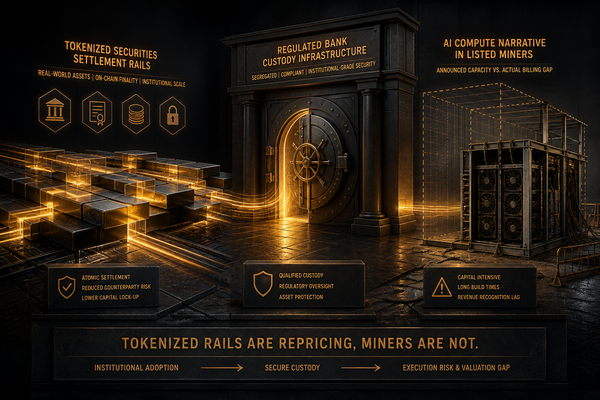
The tokenised-securities lane is where structural capital is forming. Payward's xStocks issuance of 100 LSE-listed names, with 24-hour trading pending approval, is the first credible exchange-backed bridge between UK equities and crypto rails. ICE's design-partner investment in tZERO adds institutional-grade plumbing. Securitize's EU DLT Pilot Regime project with Socios targets sports-team equity, a niche but regulatory precedent.
SBI's $270 million for 20 percent of Ajaib is the clearest Asia distribution play, combining stablecoin OTC for institutions with retail crypto. Binance's TradFi perpetuals volume at $433 billion monthly, 15 times since January, shows demand for leveraged equity exposure, but regulatory risk remains binary. Bitwise's Solana staking fund crossing $1 billion in assets is the only pure-crypto ETF signal this week.
Nvidia's $3.5 billion strategic investment in MediaTek, tied to the latter's $3.9 billion bond raise, is the clearest capital signal in the intelligence thread. Nvidia is monetising its CUDA moat by embedding IP into a rival's accelerator line, effectively taxing Taiwan's AI silicon supply chain while hedging its own foundry concentration. The structure lets Nvidia capture upside without consolidating capex.
IREN's narrative is a cautionary tale on AI-conversion optionality. Despite $4 billion in contracted annual recurring revenue from Microsoft, 82 percent of revenue remains bitcoin mining. Bernstein flags the $25-30 billion buildout as a potential equity overhang. The $20 million per IT-megawatt revenue recognition is strong, but delivery gating means cash conversion lags. Allocators should treat IREN as a high-beta call on hyperscaler capex, not a diversified AI play.
The Convergence
The connective tissue across these threads is the migration of value from technology layers to regulatory interfaces. Consider the parallel structures:
Hyperliquid is a technologically superior perpetuals venue seeking US regulatory shelter because its growth ceiling is jurisdictional, not technical. ICE is a traditional exchange investing in tokenisation infrastructure because its growth ceiling is also jurisdictional, specifically the limits of CCP-based clearing economics. CIMB is a regional bank proving that tokenised deposits can settle complex instruments, positioning itself for Gulf capital flows that will require Shariah-compliant digital rails.
Each of these is an arbitrage on regulatory boundaries. The Hyperliquid-Payward deal routes offshore perpetuals liquidity through a CFTC-regulated futures commission merchant, bridging non-US DeFi margin engines to US clearing rails. If approved, this creates a template for foreign Layer 1s to access US derivatives infrastructure without DCM status, potentially disintermediating CME's crypto perpetuals franchise. The CFTC's motion to dismiss CME's lawsuit over standing removes a key competitive moat.
The same pattern appears in the AI thread. Astra's threshold crossing will trigger export control review, creating a bifurcated global AI infrastructure. Nvidia's reported Hugging Face acquisition would make open-source AI a distribution channel for CUDA. Both are moves to control the regulatory and distribution interface, not the underlying capability.
The capital flows follow the same logic. Strategy's bitcoin accumulation is a bet on the regulatory interface between corporate balance sheets and crypto assets. The tokenised-equity buildout is a bet on the regulatory interface between securities law and blockchain settlement. Nvidia's MediaTek investment is a bet on the regulatory interface between US export controls and Taiwanese silicon.
What Could Break the Thesis
The most direct threat is regulatory stall. Hyperliquid's US expansion thesis is unproven until the CFTC approves the structure. If approval stalls, the venue remains in regulatory limbo and its growth ceiling persists. The xStocks listing faces a similar binary outcome on regulatory approval.
The second threat is leverage tolerance. Strategy's balance sheet can absorb a bitcoin correction, but the equity cushion at Strive is thin. Hyperliquid's equity facility, if deployed aggressively and markets turn, could create governance stress. The gap between authorisation and utilisation suggests caution, but that gap can close quickly.
The third threat is capability diffusion outpacing defensive tooling. Astra's threshold crossing will diffuse, and the question is whether defensive AI accelerates faster than offensive capability. The Fable 5 precedent suggests regulatory friction will slow release cycles, but that creates its own risks: models gated by jurisdiction will be developed in jurisdictions with looser controls.
The fourth threat is the CIMB settlement model attracting regulatory pushback. Bypassing RTGS and central bank money challenges Bank Negara's oversight perimeter. MAS-style pushback would set a template that constrains the model's expansion.
What to Watch Next
The Hyperliquid-Payward CFTC filing is the highest-signal item to track. Approval would create a template for foreign Layer 1s accessing US derivatives infrastructure, with direct implications for CME's franchise. Watch token price and open interest as proxies for market anticipation.
The ICE-tZERO integration timeline matters. Design-partner status is meaningful, but execution will determine whether tokenised securities run on ICE's existing stack or remain a pilot. Watch for named institutional issuers committing to the platform.
The CIMB sukuk settlement should be monitored for regulatory response. If Bank Negara signals acceptance, expect Gulf banks to explore similar structures. If pushback comes, the template constrains.
On the AI side, watch for confirmation of Nvidia's Hugging Face acquisition and the export control review triggered by Astra's threshold crossing. The Fable 5 precedent suggests an 18-day offline period is the floor, not the ceiling, for regulatory review.
Finally, watch Strategy's accumulation pace. The gap between Hyperliquid's authorised and utilised equity facility is a proxy for conviction. If utilisation accelerates, expect further BTC purchases. If it stalls, the optionality thesis weakens.