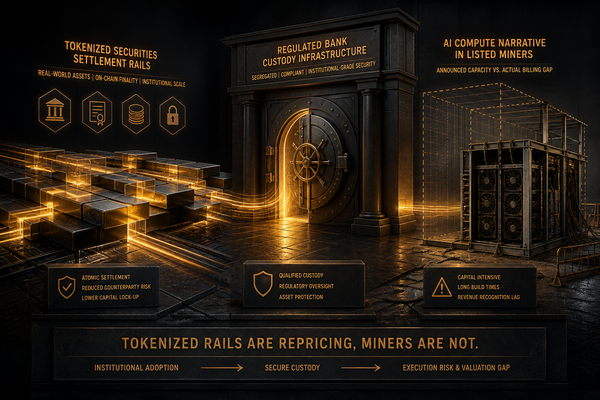
The Tollbooth Thesis: Value Migrates to Routing, Not Models
Stripe's $7B OpenRouter purchase, Citi's custody entry, and Swift's tokenized deposits signal value shifting from asset creation to access, routing, and settlement layers.


This week's capital, intelligence, and infrastructure threads converge on a single insight: value is migrating from asset creation to the layers that control access, routing, and settlement. From Stripe's $7B purchase of OpenRouter to Citi's custody entry and Swift's tokenized deposit transfer, the market is paying premium multiples for distribution and plumbing, not for the assets themselves.
The Signal
The strongest connective thread across this week's developments is the consolidation of tollbooths. Stripe's acquisition of OpenRouter for $7B is the clearest expression: a payments company buying a routing layer with no proprietary compute, no frontier models, and no GPUs. What OpenRouter owns is the billing relationship with developers and the orchestration layer between them and heterogeneous model supply. Stripe already processed those payments; now it owns the entire stack.
The same pattern appears in crypto. Citi entering Bitcoin custody, Swift's live tokenized deposit transfer between HSBC and Standard Chartered, and the SEC's proposed token-sale exemptions all point to the same conclusion: the value is in the rails, not the assets. Sovereign holders like Norway's NBIM and Abu Dhabi's Mubadala are accumulating passively through equity and ETF vehicles, not through direct purchases. They are not expressing conviction; they are expressing index-driven inertia.
Intelligence
The intelligence thread this week is dominated by inference cost collapse and the strategic response to it. OpenAI's GPT-5.6 Sol tier at 750 tokens per second via Cerebras is a genuine capability, but the more important signal is what it represents: OpenAI is now selling speed as a premium SKU. Google's Gemini 3.7 Flash, live and cheap, is the direct counter, commoditising agent inference to capture enterprise workloads before OpenAI's waitlist converts.
This is the beginning of a pricing war in agent economics. The battleground is no longer raw model capability; it is price-per-agent-task and sub-second latency at volume. OpenAI's CRO hire, Dali Rajic, signals a pivot to enterprise contract discipline, not just API volume. The Cerebras-powered tier is a strategic pricing wedge, but invite-only access caps near-term revenue contribution.
The Apple-Alibaba Qwen pairing is the most structurally significant integration. Apple's distribution muscle gives Alibaba's cloud a sovereign China AI channel, effectively monetising compute at national scale. This is not a capability leap; it is a distribution play, and a smart one. It also hardens the digital Iron Curtain: US models on TSMC and NVIDIA silicon, Chinese models on SMIC and Huawei silicon, with data residency enforced at the OS level. Cross-border model distillation becomes a sanctions-adjacent activity.
The Asana Codex claim of five years of work completed in two weeks for $12,000 is hype-adjacent but plausible if scoped to a legacy testing migration. That is exactly the kind of mechanical, high-repetition task where current agents excel. It does not generalise to novel engineering.
NVIDIA Cosmos 3 Edge, the 4B omni-model for on-device robot control, is the quiet winner. World models at the edge are a genuine capability shift, not a demo. But on-device robot control requires new compute, likely Jetson Thor-class modules, straining supply chains already allocated to automotive.
The Memory Constraint
The 500% year-on-year increase in memory prices is the sleeper signal in the intelligence thread. HBM and DDR5 scarcity will cap inference scaling, pushing routing economics toward cheaper, quantised models. This is exactly what OpenRouter optimises for. The acquisition makes even more sense in this context: Stripe is buying the layer that will benefit from memory-driven cost pressure, not the layer that suffers from it.
Infrastructure
The infrastructure thread is dense but bifurcated: capital formation rails are being rewired while compute and memory substrates hit physical limits.
The SEC's proposed token-sale exemptions are the most consequential regulatory move. If finalised, they bifurcate the Howey analysis, creating a secondary market for tokens decoupled from investment contracts. This directly impacts identity and settlement rails: expect a surge in non-custodial issuance infrastructure and a legal grey zone for KYC and AML obligations on tokenised assets. The proposal is not final, and the 2027 stablecoin seller restrictions from Treasury create a compliance cliff that could dislocate exchange revenue models.
Stripe's OpenRouter acquisition is the sleeper in this thread as well. Stripe now owns the routing layer for model inference and the payment rail for AI consumption. This is vertical integration on the AI API economy. Stripe becomes the tollbooth for both model selection and settlement, threatening Cloudflare's AI gateway and AWS Bedrock's routing ambitions. The memory price surge makes this even more strategic: routing economics will favour cheaper, quantised models, and OpenRouter is the layer that optimises for exactly that.
Citi's entry into Bitcoin custody and Swift's live tokenized deposit transfer between HSBC and Standard Chartered are the load-bearing events in institutional crypto infrastructure. Both extend existing settlement infrastructure into digital assets, reducing the need for parallel rails. Swift's interoperability layer attacks the single-bank silo problem that has capped tokenized deposit utility. If Swift's ledger becomes the settlement rail for cross-bank tokenized deposits, that is a genuine integration path for institutional capital, though it is years from scale.
Securitize's numbers underscore the gap: $4.3B in tokenized assets under management but revenue down 5% and EBITDA negative. Issuance scales, but revenue models do not yet justify the compute and compliance overhead. This is the classic infrastructure-before-monetisation pattern.
The Sovereign Balance Sheet
Abu Dhabi's Mubadala and AIC retained 22.94 million IBIT shares, worth $764M, through Q2 despite an $118M mark-to-market hit. Norway's NBIM saw indirect BTC exposure rise 60% year-on-year to 11,549 BTC, entirely passive via listed equities. These are sticky, benchmark-driven allocations, not tactical trades.
The threat is concentration. Sovereign and corporate treasuries now hold the marginal supply, making price action a function of balance-sheet decisions, not user demand. If Bitcoin breaks lower, passive holders do not provide a bid; they provide inertia. The Abu Dhabi retention is a governance artifact, not a conviction signal.
Capital
Capital flows this week bifurcate into two distinct channels: passive sovereign and index accumulation, and active corporate treasury management, with custody infrastructure maturing underneath.
The sovereign signal is unambiguous. Norway's NBIM and Abu Dhabi's Mubadala are accumulating through listed equities and ETF vehicles, not direct purchases. Paul Tudor Jones' BVI Global reversed a year of selling, lifting IBIT 18.9% to 688,529 shares worth $22.9M while slashing call options. This is a de-leveraging into spot, a lower-beta expression of the same macro thesis.
Corporate treasuries are deleveraging, not accumulating. The unnamed Bitcoin treasury company sold 600 BTC against a $60M December maturity, holding $19.1M cash and 662 unencumbered BTC. That is a tight solvency buffer. Strategy raised $334M via equity issuance to cover dividends and buybacks, leaving its BTC untouched. Metaplanet's $132M, 2,100 BTC seed into Super League is the outlier, a tokenised treasury-adjacent structure, but sub-scale.
Stripe's $7B OpenRouter acquisition is the dominant flow in the capital thread. Stripe is paying a massive multiple for a routing layer with no proprietary compute. This is a distribution and payments arbitrage play. Expect Stripe to bundle OpenRouter access into its merchant stack, pressuring pure-play inference aggregators and squeezing margins for model providers who lose direct customer relationships. The counterparty risk is OpenRouter's reliance on third-party model APIs from Anthropic, OpenAI, and Meta, a structural dependency Stripe must manage.
Cypherpunk Holdings' $33.33M equity raise with Winklevoss Capital is a targeted bet on Zcash hashrate concentration. Adding roughly 18% of network hashrate gives Cypherpunk outsized influence over block rewards and treasury accumulation. This is a capital-intensive, low-margin mining operation dressed as a strategic treasury play. The equity structure dilutes existing holders, and Zcash's long-term viability remains questionable.
The Revenue Model Gap
Securitize's numbers are the cautionary tale: $4.3B in tokenized AUM but revenue down 5% and EBITDA negative. Scale without monetisation. The same pattern appears in the AI infrastructure layer: memory prices up 500% year-on-year means margin compression across the stack and potential consolidation in memory-dependent hardware providers. The revenue model is not keeping pace with asset growth.
The Convergence
The unifying thesis across all three threads is the migration of value from asset creation to the layers that control access, routing, and settlement.
Stripe's OpenRouter acquisition is the purest expression: a payments company buying the routing layer for model inference. The value is not in the models; it is in the tollbooth between developers and heterogeneous model supply. The same logic applies to Citi's custody entry, Swift's tokenized deposit transfer, and the SEC's proposed token-sale exemptions. All are attempts to own or regulate the rails, not the assets.
The memory price surge is the binding constraint that makes this thesis coherent. HBM and DDR5 scarcity will cap inference scaling, pushing routing economics toward cheaper, quantised models. The layer that optimises for cost arbitrage and latency-aware routing is the layer that wins. OpenRouter is that layer. Stripe now owns it.
The sovereign accumulation pattern reinforces the thesis from the demand side. Norway and Abu Dhabi are not buying Bitcoin; they are buying exposure through listed equities and ETFs. They are not expressing conviction; they are expressing index-driven inertia. The marginal buyer is passive, which means the marginal price signal is weak. The real action is in the infrastructure being built underneath.
The Apple-Alibaba Qwen pairing is the geopolitical expression of the same thesis. Apple's distribution muscle gives Alibaba's cloud a sovereign China AI channel. The value is not in the model; it is in the distribution and the data residency enforcement at the OS level. The digital Iron Curtain hardens, and hyperscalers must maintain dual, non-interoperable inference fabrics.
What Could Break the Thesis
The tollbooth thesis assumes that routing and settlement layers retain pricing power. Three developments could break that assumption.
First, if memory prices continue to rise 500% year-on-year, the cost of serving long-context models becomes prohibitive for all but the largest incumbents. This favours consolidation, not tollbooths. The routing layer becomes less valuable if the underlying compute is concentrated in a few hands.
Second, if the SEC's token-sale exemptions are not finalised, or if the 2027 stablecoin seller restrictions create a compliance cliff, the regulatory optionality priced into crypto infrastructure evaporates. The GENIUS Act's synthetic stablecoin carve-out ambiguity adds further legal risk. Regulatory capital is being priced for optionality, not certainty.
Third, if sovereign holders become price-sensitive. The Abu Dhabi retention is a governance artifact, not a conviction signal. If Bitcoin breaks lower, passive holders do not provide a bid; they provide inertia. The marginal supply is now held by balance sheets, not users. Price action becomes a function of treasury decisions, not demand.
What to Watch Next
Watch Stripe's integration of OpenRouter into its merchant stack. If Stripe bundles model access with payment processing, pure-play inference aggregators face immediate margin pressure. The first earnings call mentioning OpenRouter contribution will be the signal.
Watch memory prices. The 500% year-on-year increase is the binding constraint on inference scaling. If HBM and DDR5 scarcity persists, expect consolidation in memory-dependent hardware providers and a shift toward quantised models. The routing economics that OpenRouter optimises for become more valuable, not less.
Watch the SEC's token-sale exemption proposal. If finalised, expect a surge in non-custodial issuance infrastructure and a repricing of early-stage crypto venture capital. If it stalls, the optionality premium in crypto infrastructure deflates.
Watch Apple's China rollout of Qwen-powered features. The distribution play is the most structurally significant integration this week. If it succeeds, expect other Western hardware makers to seek sovereign AI partnerships, hardening the digital Iron Curtain further.
Watch Citi's custody launch and Swift's tokenized deposit interoperability. Both are years from scale, but they are the load-bearing events in institutional crypto infrastructure. If Swift's ledger becomes the settlement rail for cross-bank tokenized deposits, that is a genuine integration path for institutional capital.
The tollbooth thesis is coherent this week. The question is whether the tollbooths retain pricing power as the underlying assets commoditise. Stripe is betting they do. The sovereign holders are betting they do not need to. The memory constraint will decide which bet is correct.