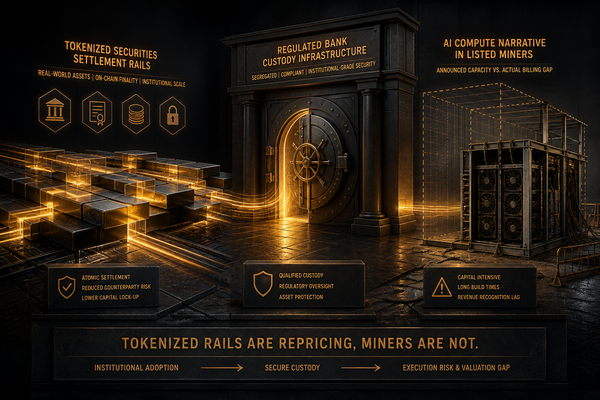
The Settlement Layer Is the New Battleground
Private networks are consolidating control of financial settlement, while regulatory fragmentation creates a two-tier market. The race to govern new rails—from stablecoins to tokenized collateral—will define the next decade of finance and AI.


The fight over who controls settlement, not who issues tokens or trains models, has become the defining contest across finance and artificial intelligence. Stablecoin regulation, tokenized collateral, ETF flows, and compute financing all point to the same structural shift.
The Signal
The most consequential development this week is not the Bitcoin rally, NVIDIA's earnings, or any single product launch. It is the quiet consolidation of settlement infrastructure around a handful of private networks, alongside the corresponding fragmentation of regulatory oversight. Visa joining Singapore's BLOOM network, EDX accepting tokenized treasuries as collateral, and Franklin Templeton folding BENJI into traditional funds all describe the same phenomenon: the plumbing of financial markets is being rebuilt, and the architects are network incumbents rather than central banks.
Meanwhile, the regulatory race to govern this new plumbing is producing chaos. The Office of the Comptroller of the Currency has missed its July deadline for stablecoin rules and now targets January. The CLARITY Act faces a September cloture vote that could fail. The Commodity Futures Trading Commission's fallback authority is a stopgap, not a regime. The result is a two-tier market: regulated dollar coins under OCC or Monetary Authority of Singapore oversight, and offshore products such as Revolut's EURR operating under Luxembourg's Markets in Crypto-Assets Regulation compliance. The gap between them is where risk accumulates.
Intelligence
The technology signal this week is thinner than the capital flows suggest. NVIDIA's AVO reaching 100 percent on ARC-AGI-3 is the most substantive claim, but the framing matters more than the result. It validates the harness over the model, which aligns with the Vera Rubin push toward agentic inference. The fourfold growth in prompt tokens across OpenRouter's 100 trillion tokens is empirical proof that workloads are shifting from single-turn latency to sustained multi-step context. CUDA Python 1.0 is the sleeper capability shift: it collapses the C++ and Python barrier, meaning the agentic tool-calling layer can now be written natively in Python with full platform access. That accelerates integration for every startup building agent infrastructure.
The Stampli case is the cleanest operational signal. Codex compressing launch cycles by 68 percent is a direct reduction in human compute-to-output latency. Software delivery becomes a function of API throughput and context-window management rather than staffing. That shifts cost curves for mid-market SaaS, but it does not touch rails. It is a productivity arbitrage, not a new substrate.
The weak signals are the ones dressed as strong. Revolut's EURR is a compliance wrapper, not a capability shift. The USD1 GitHub discrepancy is governance opacity, not novel architecture. The regulatory race is process noise: the GENIUS Act, CLARITY, and CFTC fallback all describe the same thing, clarifying which existing law applies to settled technology. No new capability emerges from a Senate cloture vote.
Infrastructure
The infrastructure signal is strong but bifurcated. Settlement rails are consolidating while regulatory rails fragment under political pressure. Visa's entry into the Monetary Authority of Singapore's BLOOM network is the key systemic move. It grafts the card network's existing merchant-acquirer plumbing onto tokenized deposit and stablecoin settlement, making Visa a clearing-layer aggregator for MAS-regulated entities. This bypasses traditional real-time gross settlement latency for cross-border flows but introduces a private settlement finality dependency. Shinhan's adoption of Visa's Stablecoin Platform extends this into Korean won corridors, creating a dual-rail system: legacy SWIFT and RTGS for fiat, Visa and BLOOM for tokenized value.
EDX accepting YLDS as collateral is the critical infrastructure signal on the asset side. It converts a tokenized treasury into a settlement-grade asset within an institutional venue backed by Citadel, Fidelity, and Schwab. This bypasses traditional tri-party repo and prime brokerage rails, making Figure's token a direct competitor to US Treasuries as margin. Coinbase's tokenized equities on Base, with Alpaca as custodian, extends this to the equity collateral stack, enabling DeFi lending against real shares. That is a direct threat to prime brokerage and securities lending desks.
The Dallas Federal Reserve's $700 billion deposit-drain warning is the anchor for understanding systemic risk. Tokenized deposits and yield-bearing securities are rate-sensitive, uninsured liabilities that will migrate to money market funds or onchain treasuries during stress. That forces banks into liquid, low-yield assets and shrinks the credit multiplier. The mechanism is disintermediation of the demand deposit franchise, the cheapest funding source for commercial lenders.
On the compute side, NVIDIA's $366 billion in future commitments against $108.5 billion in guarantee exposure converts order backlog into a contingent liability chain. Compute is now a derivatives market. The Poolside reverse-execuhire, with $6 billion for employees and a seven-gigawatt neocloud attached, prices talent as stranded infrastructure. The seven-gigawatt target is the physical manifestation, but grid interconnection and transformer lead times of 24 to 36 months may not absorb it.
Capital
The capital signal is bifurcated across all three domains. In stablecoins, regulatory arbitrage is driving issuance while settlement infrastructure consolidates around bank-grade rails. The OCC's accelerated timeline is the primary catalyst. The verifiable discrepancy between USD1's onchain wallet capabilities and its public GitHub is a governance red flag. Institutional allocators should demand audited smart-contract bytecode before treating USD1 as a cash equivalent.
In tokenized assets, the highest-leverage event is Franklin Templeton's SEC relief to bring BENJI into traditional funds. This allows the $1.8 trillion manager to allocate legacy fund assets into the tokenized money market fund, creating a conduit for institutional cash to migrate onchain without new mandates. EDX accepting YLDS as collateral is structural validation, but the flows remain small relative to the systemic risks flagged by regulators.
In crypto markets, the $606 million into US spot Bitcoin ETFs on Thursday, with BlackRock absorbing 83 percent, is the largest single-day haul since May. The four-day total of $1.61 billion suggests institutional re-risking, not retail FOMO. The $3 billion short liquidation is a mechanical accelerant, not a fundamental bid. The altcoin signal is weaker: $90 million across XRP, Solana, Chainlink, and HYPE is marginal relative to Bitcoin flows.
The risk overlay is the 30-year Treasury yield spike and the $183 billion auction window. If long-end yields break higher, the carry trade that funds Bitcoin spot demand unwinds. Crypto is now correlated with rates, meaning it behaves like a leveraged technology trade rather than a hedge.
In AI, NVIDIA's $96.2 billion quarterly print is secondary to the $366 billion in future commitments. This is NVIDIA underwriting customer capex via contractual off-take, converting GPU scarcity into a financing vehicle. Counterparty concentration risk is now systemic. A single large customer default cascades into NVIDIA's P&L. Poolside's $12 billion reverse-execuhire is talent acquisition priced as infrastructure. The $350 million BUZZ deal is marginal-capacity arbitrage with high risk of delivery failure.
The Convergence
The connective tissue across these threads is the emergence of private settlement layers as the new locus of control. Visa in BLOOM, EDX accepting YLDS, Franklin Templeton bridging BENJI into funds, Coinbase tokenizing equities, NVIDIA financing compute via guarantees, Stripe routing inference through OpenRouter: all are building parallel rails that bypass traditional public infrastructure.
The common mechanism is financialisation of the settlement layer. Stablecoins become bank-grade settlement assets under OCC or MAS oversight. Tokenized treasuries become collateral in institutional venues. Compute becomes a derivatives market with NVIDIA as the counterparty of last resort. Model distribution becomes a toll road with payment rails woven into inference routing.
The downstream consequence is a two-tier system. Regulated, bank-grade rails serve institutional flows. Offshore, compliance-wrapped products serve the rest. The gap between them is where governance risk accumulates. The USD1 wallet privilege gap, the CFTC fallback regime, the MiCA cross-border arbitrage: all are symptoms of the same fragmentation.
The second-order effect is on monetary transmission. If tokenized collateral becomes the preferred margin asset, the Federal Reserve's balance sheet and bank reserves become less relevant. Monetary policy shifts from bank lending to capital markets. The Dallas Fed's $700 billion warning is the first official acknowledgment of this mechanism.
What Could Break the Thesis
The most immediate risk is the CLARITY cloture vote in September. A failure strands CFTC fallback authority, creating a two-tier market with widened basis and custody complexity. The OCC missing its July deadline while racing January's timeline signals rulemaking under political duress, not technical readiness.
The second risk is a liquidity event in the neocloud financing stack. If NVIDIA's guarantee exposure crystallises, the entire compute derivatives market unwinds. The 24 to 36 month lead times for grid interconnection and transformers mean supply cannot adjust quickly.
The third risk is a governance failure in the tokenized asset layer. If USD1's undocumented privileges are exploited, it triggers a regulatory overcorrection that freezes the entire stablecoin market. The same applies to a breach at Hugging Face, which would push enterprises toward gated, identity-bound compute, favouring hyperscalers over neutral hubs.
The fourth risk is the Treasury yield spike. If the 30-year auction fails, the liquidity impulse reverses. ETF redemptions force Coinbase to sell spot Bitcoin into thin order books, amplifying downside. The carry trade that funds crypto spot demand unwinds.
What to Watch Next
- CLARITY cloture vote in September — the binary stress test for the stablecoin regime. A failure creates a two-tier market with regulatory arbitrage as the dominant strategy.
- 30-year Treasury auction — the liquidity signal. A failed auction reverses the impulse that drove ETF inflows and the Bitcoin rally.
- NVIDIA's guarantee book — signs of concentration stress. The $108.5 billion in exposure is the canary in the neocloud financing stack.
- Franklin Templeton's BENJI integration — the first meaningful institutional migration of legacy fund assets onchain. The HashKey listing extends distribution into Asia, but volume there is negligible.
- Visa's BLOOM participation — production metrics. No transactions per second or finality guarantees have been published. The sandbox is still a sandbox.
- USD1 GitHub repository — reconciliation with onchain wallet capabilities. Until the code matches the deployed logic, treat the token as unaudited.
The settlement layer is being rebuilt. The question is not whether it happens, but who controls the rails and who bears the risk when they fail.