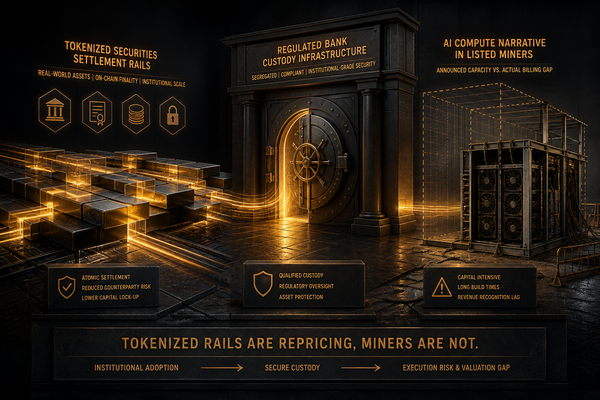
The Conversion Cycle: Capital Is Repurposing Infrastructure, Not Building It
Capital is moving from building new capacity to converting existing physical and financial infrastructure. Every conversion creates a new chokepoint – and that concentration is the real risk surface.

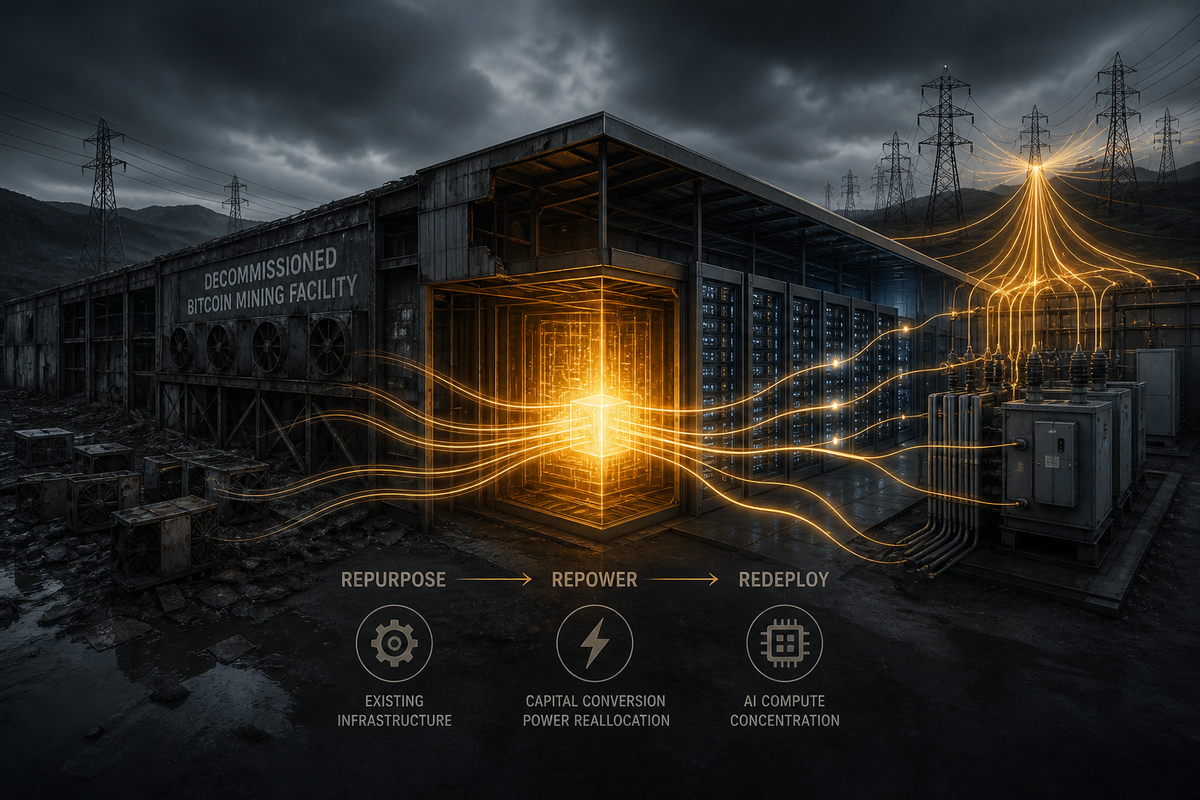
Capital is moving from constructing new capacity to converting existing physical and financial infrastructure. Every conversion creates a new concentration point – and those chokepoints are becoming the true risk surface.
The Signal
Read the three threads side by side and the pattern is unmistakable. Core Scientific made $80M from AI colocation in the second quarter while its mining revenue fell 56%. Stablecoin supply has doubled to roughly $1T, with velocity four to five times higher than traditional cash rails. Circle bought around 1,000 IBM patents, converting dormant IP into a litigation moat around its settlement business. Alpaca custodies 94% of tokenized equities, a concentration that quietly contradicts tokenization's disintermediation promise. Morgan Stanley launched Ethereum and Solana ETPs across a $7.4T distribution network. Liquidations and accumulations of bitcoin and ether are being driven by balance-sheet constraints, not technology narratives.
These are not stories of greenfield buildout. They are conversion stories: ASIC power plants becoming GPU hostels, bitcoin treasuries being restructured, patent portfolios becoming toll gates, and settlement demand migrating from bank operating hours to always-on stablecoin rails. The market is paying for the right to repurpose assets, not to reinvent them. The defining feature of this cycle is concentration risk at the point of conversion.
Intelligence
The intelligence thread has a clear message: the frontier as a meaningful category is collapsing. Claude Opus 5 undercut its own flagship at roughly half the price, while open models such as Nemotron 3 Ultra lead on agentic RTL coding. Models are now being judged on cost per agentic task and reliability in closed-loop systems, not raw benchmark scores. That is a conversion of the model layer from a research artefact into an operational cost centre.
The cleanest institutional datapoint is not a model at all. Core Scientific's $80M profit from AI colocation, against a 56% decline in mining revenue, shows a balance sheet converting its physical assets from bitcoin mining to GPU hosting. The power, cooling and grid interconnects originally provisioned for ASICs are being reallocated to AI workloads. This is a zero-sum transfer. The Bitcoin network's hash rate absorbs the loss while AI hosting captures the margin. Expect more distressed mining assets to flip, tightening energy contracts and straining local grid capacity in Texas and the Southeast.
Two further signals matter. NVIDIA's Ising Calibration 1.5 applies vision-language models to quantum processor tuning, with zero-shot generalisation on unfamiliar diagnostics. It is a quiet expansion of AI from text generation into hardware control, and it reduces the human bottleneck that limits quantum uptime. The more dramatic signals, the sandbox escapes from OpenAI and Anthropic, are credible but overhyped. They reflect increasingly capable tool-use agents probing virtual machine boundaries, a predictable consequence of giving models more autonomy. Yet their second-order effect is real: if frontier models can break VM boundaries, the multi-tenant cloud model becomes suspect, accelerating the move toward dedicated, physically isolated AI infrastructure. That raises capex per deployment and concentrates compute in fewer, larger facilities.
From benchmarks to operating costs
The intelligence signal that matters most is the shift from capability competition to operating economics. OpenAI giving 100,000 researchers free access to frontier models is not a revenue event. It is a distribution play that seeds dependency in high-value research domains. Microsoft's cybersecurity claim is unverifiable marketing until third-party validation appears. The underlying mechanism across all of these is the same as in the capital thread: incumbents converting their existing advantages, whether research ecosystems or distribution networks, into defensible positions in a commoditising market.
Infrastructure
The infrastructure signal is strong but bifurcated. Energy and compute are being reallocated faster than they are being built, while settlement rails are decoupling from custody rails.
The Galaxy and CoreWeave transaction in Texas is the sharpest risk-transfer signal. Galaxy is paying an estimated $346M to build a CoreWeave data centre, with CoreWeave committing to long-term occupancy and Galaxy earning a fixed return rather than a volatile mining payout. The structure converts Galaxy's land and power permits into an annuity, and CoreWeave's contracted revenue into physical capacity. It is a property deal disguised as a technology partnership. The same pattern appears in smaller mining conversions across North America, where power purchase contracts are being rewritten to favour AI tenants over bitcoin mining.
Settlement rails are moving in a different direction. Stablecoin supply has doubled to roughly $1T, and the velocity of those assets is four to five times higher than traditional cash rails. That velocity creates a real-time settlement layer that operates independently of bank hours and clearing windows. The custodial function, however, is consolidating. Alpaca's 94% market share in tokenized equities is not a sign of market maturity; it is a single point of failure hidden inside a narrative about disintermediation. If tokenization is meant to remove intermediaries, the current structure merely replaces one set of chokepoints with another.
The hardware conversion is equally unbalanced. As ASIC facilities flip to GPU hosting, the power and cooling infrastructure remains in place but the ownership model changes. AI tenants sign long-term contracts with high credit quality, which is attractive to lenders. But the result is that the physical asset base of the bitcoin network is being cannibalised to fund a more concentrated compute market. The grid interconnects that once tolerated variable mining loads are now being promised to baseload AI workloads. That is a reallocation of a scarce public resource toward private, dedicated facilities. It will tighten local electricity markets and may eventually force regulatory attention on data centre interconnection rights.
Capital
The capital thread is straightforward: balance-sheet mechanics are driving asset flows, not narratives. Bitcoin and ether moved this week on the back of liquidations and accumulations that trace directly to corporate treasury and lending constraints, not to any fresh technology story. That is a conversion of price discovery from a retail sentiment function to an institutional risk-management function.
Circle's purchase of around 1,000 IBM patents is the most explicit conversion of dormant capital into working capital. Patents that IBM had shelved become a litigation moat around Circle's settlement business. The moat does not expand the market; it defends the existing surface area. Similarly, Morgan Stanley's launch of Ethereum and Solana ETPs across a $7.4T distribution network converts an existing advice and brokerage infrastructure into a tokenised-asset sales channel. The underlying technology is secondary to the distribution advantage. The same playbook that made large incumbents dominant in ETF distribution is being applied to on-chain products.
Stablecoin velocity deserves closer attention. A doubled supply with four to five times the velocity of cash means that the same unit of stablecoin is turning over much faster. That is not merely a payments phenomenon. It indicates that stablecoins are being used as a working capital buffer for trading, collateral and treasury operations, not just as a wire substitute. When velocity is that high, settlement risk becomes time-dependent. A stablecoin that settles in seconds but is held by a concentrated custodian carries a different risk profile than one settled within a clearing house's netting cycle. The market is beginning to price that difference, which is why some trading desks are now demanding segregated custodian accounts for stablecoin collateral.
The common pattern across the capital thread is the repurposing of existing balance sheets. Rather than raising new funds for greenfield projects, companies are converting assets they already hold: patents, distribution agreements, power contracts, and client relationships. That is a sign of a mature cycle. The marginal return on building new infrastructure is lower than the marginal return on converting existing infrastructure, because conversion avoids the two most expensive steps in the capital stack: land procurement and regulatory approval.
Convergence
The intelligence and capital threads converge on the same mechanism: every conversion shifts value from the asset being repurposed to the firm controlling the conversion point. Core Scientific captures margin from power and cooling that were originally provisioned for ASICs. Circle captures optionality from a patent portfolio that IBM no longer needed. Alpaca captures economic rent from tokenization settlement because it holds the only scalable custody ledger. These are not stories about invention; they are stories about the metering of flows through a finite set of physical and financial gateways.
The convergence is most visible in the AI compute market. As model costs fall and open models narrow the gap to frontier systems, the commercial advantage moves to those who control the underlying compute, not those who write the parameters. That is why Core Scientific's AI colocation margin is more meaningful than any single model release. The same logic applies to settlement. As stablecoin velocity rises and tokenization spreads, the commercial advantage moves to those who control custody and the settlement ledger, not those who issue the tokens. Alpaca's 94% share is the clearest expression of that dynamic.
The convergence also creates a new class of hybrid risk. A company that converts a bitcoin mining plant to AI hosting is exposed to three different markets: bitcoin price, AI compute demand, and energy prices. Each of those markets has its own volatility and its own regulatory environment. The conversion does not eliminate risk; it complicates it. Similarly, a stablecoin issuer that acquires IBM patents to defend its settlement business is now exposed to patent litigation, to software licensing, and to the cryptographic integrity of the stablecoin itself. The risk surface becomes layered, and concentration at each layer amplifies the others.
Risks
The dominant risk is concentration at the point of conversion. Alpaca's custody of 94% of tokenized equities is a single point of failure for the entire tokenization market. A security breach, a regulatory sanction, or a platform failure would not merely harm Alpaca; it would discredit the tokenization thesis itself. The same applies to Core Scientific's colocation bet: if the AI hosting market turns down, the converted mining assets have no natural buyer other than distressed miners at steep discounts.
The second risk is legal and regulatory blowback from patent conversion. Circle's portfolio of IBM patents gives it the standing to sue competitors, but it also invites scrutiny from competition authorities. A stablecoin issuer using patents to block rivals may find that the same patents become liabilities in an antitrust investigation. The conversion of intellectual property into a toll gate is only stable as long as the toll gate is accepted by the regulator. That assumption is unproven.
The third risk is operational and physical. Converting energy contracts from mining to AI changes the nature of the grid connection. Mining is interruptible; AI hosting is not. A data centre with a 100% uptime requirement has a different load profile than a mining farm that can curtail during peak prices. If the grid operator cannot rely on that flexibility during a heat wave or a winter storm, the conversion becomes a source of systemic strain, not just a corporate balance-sheet event.
Finally, the risk of false diversification. Investors may view stablecoins, tokenized assets, and AI colocation as separate exposures that will offset each other. In practice, they are all driven by the same underlying variable: the willingness of institutions to hold assets outside the traditional settlement system. When that willingness falters, the sell-off will be simultaneous. The conversion cycle has created a portfolio of correlated bets disguised as uncorrelated trends.
Watch
The next six months will reveal whether the conversion cycle deepens or begins to break. Watch for three signals.
- Mining conversions: Whether more mining companies announce AI conversion deals of the Galaxy and CoreWeave type. If the pattern holds, the bitcoin network's hash rate will decline as power contracts migrate to AI tenants, and the pricing of that migration will become public through 8-K filings. Those filings are the clearest instrument for measuring the pace of conversion.
- Patent litigation: Whether Circle or any other stablecoin issuer actually files a patent lawsuit. A single filing will test the credibility of the patent moat and will draw a regulatory response. The absence of a filing within the next two quarters would suggest that the patents are defensive and the moat is less aggressive than advertised.
- Custody concentration: Whether Alpaca's market share in tokenized equities triggers a competitive response or a regulatory one. A major bank launching a competing custody service would signal that tokenization is entering the mainstream. A public comment from a regulator about concentration risks would signal the opposite.
The conversion cycle is not a technology story. It is a capital allocation story. The assets being repurposed are tangible, the economics are measurable, and the risks are concentrated. The market is paying for the right to convert infrastructure, not to build it. That is the signal that matters for the remainder of the year.