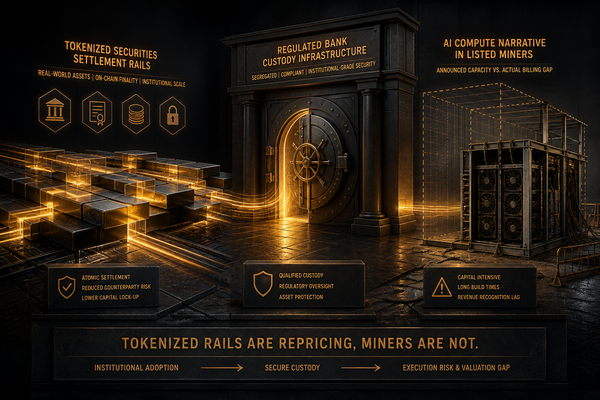
Capital, Compute, and Settlement: The Three-Movement Convergence

Capital, Compute, and Settlement: The Three-Movement Convergence
I watched three things happen this week. They looked separate. They are not.
Capital is rotating out of passive bitcoin treasuries. It is moving into active AI infrastructure. The settlement layer for that deployment is being built with stablecoins, not speculative tokens. The pressure forcing that rotation comes from debt covenants, listing rules, and rebalancing constraints. Holding bitcoin on a corporate balance sheet is becoming less attractive than owning the compute floor beneath AI workloads.
The three threads are sequential. The Bitcoin treasury firms are the source of the capital. The miners are the physical receptors. The stablecoin issuers and their rail builders are the payment fabric that connects them.
I have been reading capital flows for a living since I lost thousands of Bitcoin in 2013. I build AI systems now. This is what I see.
I. Stablecoins Become the Settlement Skeleton
The most infrastructural story of the week was quiet. Standard Chartered became the first G-SIB to offer direct USDC minting and redemption for institutional clients. That is not a press release. It is a structural shift.
Before this, large allocators accessed stablecoin liquidity through exchanges or OTC desks. Those introduce counterparty risk and settlement latency. Standard Chartered plugs USDC into the same SWIFT-adjacent plumbing that global banks use for dollar clearing. A pension fund can now move from fiat to programmable dollars without leaving the regulated banking envelope.
I bought into that envelope myself last year. It matters.
Cloudflare launched its Monetization Gateway. They revived the HTTP 402 status code for AI-agent payments over Coinbase's x402 protocol. The architecture is dead simple. An AI tool charges per API call or per dataset query. Settlement happens in USDC directly on the CDN edge. No invoices. No card networks. No human approval for each microtransaction.
That is a capability milestone. Programmable money that an LLM can spend without a human wallet. The gateway is currently waitlisted. That is the right sign. Early, not overhyped.
On settlement volume, the data confirms the shift. Base moved $565 billion in stablecoins. That proves L2 throughput can carry institutional wire-level flows without congestion. Solana's tokenised RWA transfer volume hit $8.7 billion in 30 days. Doubling month-on-month. Securitize, the tokenisation platform backed by BlackRock, expanded into Solana and Avalanche. They added regulated share issuance to the high-velocity chain.
The directional flow is clear. Tokenised securities will settle on the chains that already carry stablecoin volume. Not the other way around.
The regulatory environment is hardening alongside the infrastructure. The GENIUS Act, with its July 18 rulemaking deadline, will impose compliance costs. It will cull smaller stablecoin issuers. Tether froze 134 wallets linked to ISIS on Tron. The U.S. Treasury sanctioned the same addresses. A joint operation that embeds public-chain intelligence into issuer kill-switch enforcement.
The digital ruble will launch September 1 via state-owned banks. That creates a domestic payments reshoring corridor. It also functions as sanctions evasion plumbing.
The net effect is a bifurcation. Regulated stablecoins — USDC, RLUSD — become the compliant settlement layer for institutional and AI-agent flows. Unregulated issuers become liability magnets.
II. Compute Repurposing and Capital Convergence
The second movement is the physical convergence of crypto mining infrastructure with AI training clusters. TeraWulf's 20-year, $19 billion lease agreement with Anthropic is the defining deal of the quarter. A revenue-guarantee contract that reframes bitcoin miners as AI compute landlords.
TeraWulf has existing power contracts and substation access. Those take years to replicate. Anthropic needs guaranteed megawatts at fixed prices to build its next training cluster. The lease transfers the price risk of power to the landlord and the volume risk of compute utilisation to the tenant.
It is not a pivot. It is a property lease with an energy arbitrage built in.
The market responded accordingly. Mining stocks — MARA, RIOT, CLSK — rallied on the implied optionality. Any miner with stranded power capacity could follow TeraWulf's path. But the capital cost is real. Riot's 500 BTC custody transfer, reported as a collateral move or OTC sale, signals funding pressure. They need to finance AI infrastructure capex.
The economics of a mining retrofit require either equity dilution or debt. Debt markets remain wary of bitcoin volatility. The BTC treasury firms that hold large unrealised gains are becoming the ATMs for this build-out. But only if they can sell without cratering their own stock price.
Paradigm's $1.2 billion Fund IV is the largest dedicated crypto VC raise since 2022. Its mandate explicitly includes AI, robotics, and crypto startups. That broadening is a capital signal. The thesis is no longer "crypto replaces finance." It is "crypto optimises the infrastructure layer for agentic AI."
The fund's size gives it pricing power in early-stage compute-layer companies. Its deployment will concentrate on markets that bridge token incentives with physical compute procurement. Decentralised GPU marketplaces. Coordination protocols for training runs. Settlement rails for machine payments.
OpenAI's proposed $42 billion equity sale to the U.S. government is a 5% stake implying an $840 billion valuation. That introduces sovereign balance sheet integration into AI development. If executed, it ties the control of model weights and inference to federal interests. It raises governance risks for private co-investors. It raises exit risks for those hoping for a free market in foundational models.
The move signals that the largest AI builders see state capital as the only capital pool large enough to sustain frontier training costs. The side effect is that open-source models will face increasing compute disadvantage and regulatory asymmetry.
NVIDIA's Vera CPU announcement is the hardware anchor. Vera targets the CPU bottleneck in agentic workflows. The latency between GPU inference steps when an agent must execute tool calls, retrieval, or code. By increasing core count and fabric throughput, Vera reduces that inter-step stall. It enables more complex agentic loops.
This is not a consumer chip. It is a factory-floor upgrade for the data centres that Anthropic, OpenAI, and others are building. The Vera cycle, combined with the TeraWulf lease, defines the compute floor for the next generation of autonomous agents. That floor is being built on repurposed bitcoin miner infrastructure.
III. Bitcoin Treasury Firms Under Pressure: The Forcing Function
The third movement is the stress showing in corporate bitcoin balance sheets.
Strategy, formerly MicroStrategy, sold $216 million worth of BTC under its monetisation programme. They needed to fund preferred dividend payments. This is not a tactical trim. It compounds an $8.3 billion quarterly loss. It represents a structural outflow from the largest corporate holder.
Metaplanet added 2,823 BTC in the second quarter but financed the purchase with debt. Its 43,000-BTC stack sits below cost basis. That limits its ability to issue equity or raise further debt. BitMine deployed $73 million into Ethereum. A rotation away from bitcoin. It signals treasury managers are diversifying away from single-asset concentration.
The most telling event was an unnamed U.S. bitcoin treasury firm that liquidated its entire BTC position. Size undisclosed. Under Nasdaq listing pressure. The company explicitly linked the sale to debt repayment and a pivot to AI services.
That is not an isolated incident. It is a template.
Corporate treasuries that borrowed against bitcoin during the 2021-2022 bull run are now facing margin calls or covenant violations. The price trades range-bound. The forced liquidations propagate price pressure into ETF order flow. A self-reinforcing cycle.
ETF inflows offered an offset but with mechanical ceilings. U.S. spot bitcoin ETFs attracted $223 million in net inflows the week ending July 6. The largest since May. A weak jobs report drove demand for alternative assets. BlackRock's IBIT absorbed $209 million of that.
However, BlackRock's 1-2% allocation cap on bitcoin in its model portfolios introduces a rebalancing constraint. As the price rises, advisors must sell to stay within the band. That creates latent sell pressure. The cap works as a dampener on upside while providing a floor on downside when prices drop and advisors buy to rebalance.
This is not bullish or bearish. It is volatility-reducing infrastructure. It makes bitcoin a slower, more bond-like asset in institutional portfolios.
Vanguard posted a job listing for a Head of Digital Assets. That signals eventual product access for its 50 million retail clients. A multi-year ramp, not a near-term bid. But it confirms that the ETF custody rails will eventually absorb the $124 trillion boomer wealth transfer.
That transfer will route through trust and estate infrastructure. It makes bitcoin a multi-generational balance sheet asset rather than a high-beta trading pair. The immediate consequence is that corporate treasury liquidations and rebalancing caps will dominate the supply-demand dynamics for the next six to twelve months.
What This Week Means for Early Positioning
The week's three movements converge on a single directional bet. Capital, compute, and settlement are all flowing into the infrastructure that will power autonomous agents.
For an allocator trying to position early, the implications are concrete.
First, on settlement, prioritise regulated stablecoin issuers. Circle's USDC and likely Ripple's RLUSD over unregulated alternatives. The GENIUS Act and MiCA will create a two-tier market where only compliant issuers can serve institutional and AI-agent flows. Base and Solana have the volume to carry those flows. Ethereum L1's role will shrink to final settlement for large batches.
Second, on compute, the TeraWulf-Anthropic lease is a blueprint. Miners with long-dated power contracts and grid interconnect capacity are acquisition targets or joint-venture partners for AI firms. The pure-play bitcoin miner thesis is fading. The AI-compute landlord thesis is emerging. Riot's custody transfer suggests that even well-capitalised miners will need to sell bitcoin or dilute equity to fund retrofits. Avoid over-levered treasuries. Favour miners with free cash flow and low debt. Or better, the energy infrastructure itself.
Third, on treasury strategy, the era of borrowing against bitcoin to buy more bitcoin is ending. The forced liquidations and rebalancing caps mean that holding bitcoin on a corporate balance sheet now requires active hedging or a willingness to sell into strength. The pivot trade is away from holding the asset and towards owning the infrastructure that serves the AI-crypto convergence. That means positions in regulated stablecoin issuers, compliant tokenisation platforms (Securitize, Ondo), and AI compute lessors (TeraWulf, if it goes public, or private-side equivalents).
The numbers tell the story. $19 billion in compute leases. $8.7 billion in RWA transfers on a single chain. $565 billion in L2 stablecoin settlement. $216 million in treasury sales funding a pivot. $42 billion in sovereign equity proposed for the largest AI lab.
These are not fragments. They are the same arc, visible in three different frames.
I have been wrong before. I bought at the top in 2013. I am telling you what I see right now.
The wise move is to stop treating them as separate stories and start allocating as if one map fits all three.