The Great Repurposing: Stablecoin Rails and Bitcoin Megawatts Find Their New Homes


The Great Repurposing: Stablecoin Rails and Bitcoin Megawatts Find Their New Homes
I have been watching two processes this week. They look separate. They are not.
I traded forex for years. Lost thousands of Bitcoin in 2013 because I thought the price would come back. It did not. Not for me. Now I read capital flows for a living. Build AI systems that read them faster than I can.
The pattern I see this week is absorption. Two kinds. Stablecoins being pulled into regulated payment infrastructure. Bitcoin mining capacity being pulled into AI compute. These are not the same story but they share a structure. Early bets on infrastructure that the system eventually owns, not bypasses.
The third movement is the counterpoint. Bitcoin credit markets cracking under rate pressure. That is the residue of the last cycle. It shows what happens when financial engineering on top of real infrastructure fails to adapt.
The first two movements connect through repurposing. The third sharpens the lesson.
Movement One: Stablecoin Settlement Gets a Bank Suit
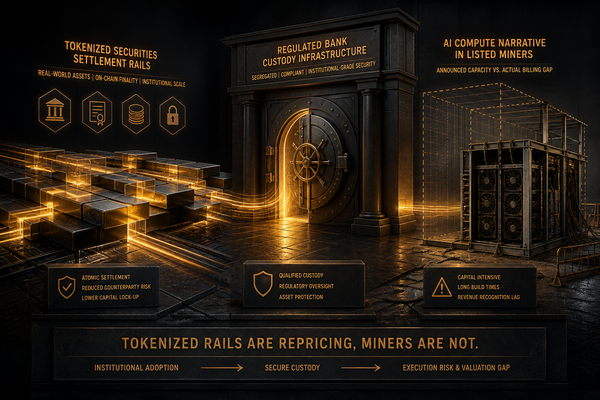
The single most signal-rich transaction this week was Nuvei buying Payoneer for $2.75bn. All cash. The combined entity processes over $500bn annually. The stated rationale is explicit: merge stablecoin receipt and payout rails into regulated bank networks.
This is not a bet on crypto displacing banking. I have seen that bet before. It loses. This is a bet that token settlement becomes a backend cost-saver inside licensed infrastructure. Invisible to the end user.
The venture market confirmed the direction. Trace Finance raised $32m in a Series A led by CoinFund. Coinbase Ventures participated. The round values the company at roughly $150m. Trace builds compliant routing infrastructure. It maps which stablecoins satisfy which jurisdiction's KYC rules before they hit the merchant's settlement account.
These commercial moves were reinforced by regulatory ones. The Federal Reserve and FinCEN jointly proposed bank-level Customer Identification Program standards for stablecoin issuers. The requirement is stark: issuers must verify the identity of every token holder at issuance.
The EU's MiCA regulation has its July 2027 deadline. Cash-reserve requirements. A €10,000 transaction limit for unverified wallets. Ireland published a 30-point AML action plan this week. Domestic enforcement teeth.
The consequence is concentration. Circle's USDC and Paxos's regulated stablecoins are structurally advantaged. They already operate under New York's BitLicense. Audited monthly.
Tether showed vulnerability. The firm froze $72m in USDT linked to a Monero-facilitated money-laundering sting. Law enforcement pressure forced the freeze. A reminder that even the largest issuer can be coerced into enforcement actions. Any fund holding frozen assets faces liquidity risk.
Compliance costs are becoming moats. The moats are owned by incumbents.
For capital positioning, the implication is clear. The stablecoin thesis is no longer about disintermediation. It is about efficiency inside regulated rails. The winners will be issuers and orchestrators who can absorb compliance costs at scale and offer settlement speeds that undercut SWIFT without exposing counterparties to regulatory risk.
Circle. Nuvei-Payoneer. Trace Finance. All early in that buildout.
The losers will be the non-compliant or the undercapitalised. I have seen that movie before too.
Movement Two: Bitcoin Credit Cracks While Mining Capacity Finds a Higher Bid
The same week that stablecoins moved deeper into banking infrastructure, the financial machinery built on top of Bitcoin suffered a material stress test.
The $10.5bn perpetual preferred shares issued by Strategy and Strive broke below $82.50. A drop of 17% from par. The trigger was the Fed's updated 2026 dot plot projecting rates at 3.8%. Not a disaster. But enough to reprice the discount rates used to value these perpetual instruments. The margin calls that followed cascaded through a roughly $10bn digital-credit market that had grown accustomed to low-rate liquidity.
The consequence for Strategy is direct. If STRC stays below $90, redemptions will shrink the pool of new issuance. That compresses the company's primary capital-raising vehicle for Bitcoin purchases. The implied funding cost just repriced higher.
For a firm whose entire treasury strategy depends on the spread between the cost of capital and Bitcoin's appreciation, this is a structural threat.
The network itself saw a rebound in activity. CryptoQuant's on-chain index reached its highest since 2024. But that recovery may be partly driven by miner-issued tokens or protocol upgrades. Not organic payments demand. The divergence between rising blockchain utilisation and weakening financial rails is worth watching.
I bought Bitcoin in 2013 on a peer-to-peer exchange. I watched it go to zero and come back. I know what organic demand looks like. This is not quite it.
But the same physical infrastructure that underpins Bitcoin mining is now finding a second life. This is the week's most important link between the Bitcoin and AI stories.
HIVE Digital Technologies announced a $220m GPU contract with Bell Canada and the AI company Cohere. Three-year term. HIVE will deploy NVIDIA H100 and Blackwell GPUs in its existing data centres. Repurposing the power and cooling capacity originally built for proof-of-work mining. Bell provides network-grade connectivity. Cohere brings enterprise LLM software.
This is the clearest example yet of a miner converting baseload power from block production to compute.
VanEck published a valuation framework formalising the shift. The paper argues that a megawatt leased to AI inference trades at a 4x to 6x premium over the same megawatt dedicated to Bitcoin mining. Based on current revenue-per-MW benchmarks for HPC colocation.
The implication is that miners with existing high-performance computing facilities are sitting on option value that markets have only begun to price. Not just power shells. Actual HPC-grade facilities.
HIVE. Core Scientific with its CoreWeave partnership. Riot Platforms which has announced HPC site assessments. These miners are ahead of peers still raising capital for new builds.
This repurposing is not without trade-offs. Every megawatt diverted to AI compute is a megawatt no longer securing the Bitcoin network. The hash rate may plateau or even decline in regions where miners convert.
But the revenue diversification is real. AI contracts lock in three- to five-year terms at contracted pricing. That decouples miner revenue from Bitcoin price volatility.
For the energy grid, this creates a more predictable load profile. AI workloads are more continuous than the opportunistic load-shedding that Bitcoin miners offer during demand peaks. Texas regulators, already renegotiating data centre tax exemptions and requiring facilities to fund grid costs, will likely prefer AI tenants over miners. I can see that coming.
Movement Three: AI Scaling Hits the Grid and Breaks the Export Control Narrative
The week's AI story is not about a new frontier model. There is none. It is about infrastructure constraints and silicon realignment.
NVIDIA swept MLPerf Training 6.0 on its Blackwell architecture. The improvement was incremental. Better per-accelerator efficiency. No architectural surprise.
The more consequential technology signal came from China. Z.AI released GLM-5.2. A large language model trained entirely on Huawei Ascend hardware. Achieving near-Claude Opus-level coding benchmarks at 82% lower token cost than equivalent Western models.
The practical implication is that export controls on NVIDIA chips are not stopping frontier capability from being developed. They are accelerating the build of a parallel silicon ecosystem.
For any company planning inference infrastructure outside China, the cost floor just dropped. I do not know how that plays out. But I know that when the floor drops, the structure shifts.
Enterprise deployment continued its steady march. Samsung rolled out ChatGPT Enterprise and Codex Code Interpreter to its entire global workforce. One of OpenAI's largest revenue contracts. Likely in the high-seven to low-eight-figure annual recurring range. The deal includes new spend controls and usage analytics that effectively embed identity management into AI usage.
This is the kind of contract that turns AI from an experiment into a line item. I have seen that before with cloud computing. It matters.
Energy remains the binding constraint. Texas Governor Abbott directed data centres to fund grid costs through a revised tariff structure. Directly threatening the unit economics of large compute clusters in the ERCOT region.
Simultaneously, CAISO reported that solar generation surpassed natural gas for the first time in H1 2026. Rising 21% over 2024 levels. The Permian basin's gas production continues to grow faster than oil. 60% increase from 2021 to 2025. Creating a supply buffer for peaker plants.
The tension is between renewable intermittency and the 24/7 demand of AI training. No grid operator has solved this yet. The premium for firm, dispatchable power will rise. I am putting capital toward that thesis.
On the agentic frontier, Estonia's government proposed a national digital ID framework for autonomous AI agents. A separate identification code from the owner. Allowing agents to enter contracts, hold limited assets, and be liable for their actions.
NVIDIA's ENPIRE programme uses Codex and Claude Code to autonomously write training code for robot fleets without human oversight. A real, narrow implementation of the same concept.
The combination of identity rails and closed-loop autonomous coding is early-stage but structurally significant. It turns agents from tools into counterparties.
I am not sure about the timeline. But I recognise the shape.
What the Week Means for Early Positioning
For someone trying to position capital or attention ahead of the next cycle, the week clarifies three themes.
First, stablecoin infrastructure is becoming regulated payment infrastructure. The bets worth making are on compliant issuers like Circle and Paxos. Orchestration layers like Trace Finance. Merchant acquirers that can embed stablecoin settlement inside licensed rails like Nuvei-Payoneer and Stripe. The premium is on regulatory moats, not technological novelty.
Second, Bitcoin mining capacity is the most undervalued physical asset in AI compute. The HIVE-Bell-Cohere deal is a template. Miners with existing HPC-grade facilities, long-dated power contracts, and cooling infrastructure can convert to AI at a fraction of the cost of greenfield data centres. VanEck's valuation framework gives investors a lens. If a miner's megawatt of capacity can earn $1m in Bitcoin revenue, the same megawatt might earn $4m to $6m in AI compute revenue. That gap is the option value.
Third, the Bitcoin credit market is a warning, not an opportunity. The STRC stress shows that financial engineering layered on top of a volatile base asset breaks when rates rise. Strategy's model works in a falling-rate environment. In a steady-rate environment above 3.5%, the cost of perpetual preferred shares becomes punitive. The physical repurposing of Bitcoin infrastructure is durable. The financial repurposing is not.
The week's through-line is that the system is absorbing crypto assets into its core functions. Settlement and compute. While discarding the financial constructs that tried to profit from them without providing real utility.
Position early on the absorption side. The infrastructure will outlast the synthetic structures built on top of it.
I could be wrong about the timing. I was wrong in 2013. But I am not wrong about the structure. I read capital flows. This is where they are going.