I’ve Seen This Pattern Before. Two Rails, One Economy.

I’ve Seen This Pattern Before. Two Rails, One Economy.
I lost thousands of Bitcoin in 2013. I know how hard it is to hold when the noise drowns the signal. I now read capital flows for a living. I build AI systems to track them. This week, the market moved on two fronts. Not one story. Two. They are accelerating independently. Each needs its own capital, its own technology, its own regulatory scaffolding. On one side, the AI model race intensifies. New entrants. Geopolitical friction. A $29.4 billion capital raise to feed compute. On the other, stablecoins and tokenised assets cross from crypto-native experiments into institutional financial infrastructure. Backed by Visa. Mastercard. Wall Street balance sheets. These are distinct movements. Not a unified story. But both are early positioning plays in the same long game: building the operating system for the next economy. One front is about intelligence and the hardware to run it. The other is about money and the rails to move it. Both demand disciplined attention. I am paying attention.
Movement One: The AI Model Race Hits Compute, Capital, and Geopolitical Constraints
The most consequential capital event of the week was SK Hynix filing for a $29.4 billion Nasdaq offering under the ticker SKHY. This is not a speculative raise. It funds advanced chip fabrication capacity for high-bandwidth memory. HBM. Directly feeds Nvidia’s supply chain. The size and purpose signal something clear: the largest allocators in semiconductors expect AI model demand to sustain exponential growth in compute. Not deflate. For institutional capital, this is the purest bet on the thesis. The AI model race is a hardware race. Whoever controls memory supply captures a toll on every inference and every training run. I bought that thesis years ago. It still holds.
That race now includes a new entrant that reshapes the pricing landscape. Meituan’s LongCat-2.0. A 1.6 trillion-parameter mixture-of-experts model. It topped OpenRouter for months under the alias “Owl Alpha.” Stealth deployment at production scale. Undercutting GPT-5.5 and Claude Sonnet 5 on price by wide margins. This is genuine engineering credibility. LongCat-2.0 likely trails the frontier labs on hard reasoning. But its cost-efficiency forces the entire inference pricing curve downward. For allocators, this means margin compression across cloud providers and AI-as-a-service business models. The winners will be those with proprietary hardware cost advantages. SK Hynix. TSMC. Nvidia. Not the model labs themselves. I’ve seen this movie before. In the cloud wars. In the mobile chip wars. The toll collectors win.
The frontier labs are not standing still. OpenAI released GPT-5.6 Sol. Credible coding and cybersecurity improvements. Anthropic matched with Claude Sonnet 5. But both face rollout restrictions from the Trump administration. They asked OpenAI to limit GPT-5.6’s deployment. Issued export orders affecting Anthropic’s Fable and Mythos models. This injects geopolitical friction into commercialisation timelines. Anthropic also alleged that Alibaba-affiliated operators created 25,000 fraudulent accounts. Conducted 28.8 million model exchanges to distill its systems. An escalation of the intellectual property war. It will harden identity infrastructure across the stack. The Linux Foundation’s Akrites coalition, with 19 members including labs and banks, launched to defend open-source repositories from AI-powered attacks. The first defensive infrastructure consortium of its kind. I take note.
Enterprise adoption remains real but incremental. HP announced a partnership with OpenAI for workforce deployment. No capital figure disclosed. This is integration plumbing. Not a breakthrough. The noise is louder than the signal. Venice AI reached a $1 billion valuation as a privacy-focused wrapper. No fresh fundraising round evident. Story Protocol pivoted from its failed IP token, down 98%, to a training data network. A desperation move. Not a technology advance. California launched an AI unemployment tracker. OpenAI published an EU workforce mapping report. Policy signals that formalise displacement monitoring. Not capital flows.
The week’s strongest technology signal is LongCat-2.0’s cost-efficient scale. The strongest capital signal is SK Hynix’s $29.4B listing. Together, they reinforce a single insight. The AI infrastructure build-out is shifting from a model capability arms race to infrastructure optimisation and capital-intensive hardware deployment. The next phase belongs to the suppliers of compute. Not the builders of intelligence alone. I am positioned accordingly.
Movement Two: Stablecoins and Tokenised Assets Cross into Institutional Infrastructure
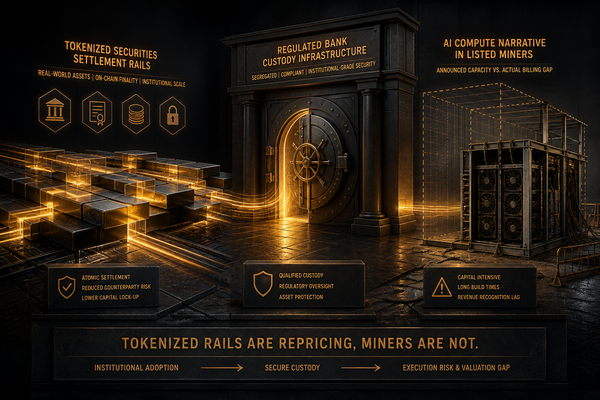
A separate but equally important push is happening in financial infrastructure. Stablecoins are migrating from crypto trading corridors to core payment and settlement rails. Tokenised assets are attracting balance-sheet commitments from insurers and exchanges. I have been watching this for years. It is no longer theoretical.
The signal event is the launch of Open USD. A regulated stablecoin consortium backed by Visa, Mastercard, and Google as infrastructure partners. This is a direct challenge to USDC and USDT dominance in institutional payments. Open USD targets integration with existing card networks and digital wallets. It competes with FedNow and tokenised deposits. For institutional allocators, this signals that non-bank stablecoin issuers are embedding into the physical economy. Not just the crypto market. The consortium structure spreads compliance and liquidity risk. That makes it more palatable to risk-averse counterparties. I have seen this consortium model work before. In credit card networks. In payment systems. It tends to win.
Ripple’s RLUSD went live in Japan through SBI VC Trade. The first foreign-issued stablecoin approved under Japan’s Payment Services Act. SBI Holdings is the distribution counterparty. Institutional and retail access. Circle and Nomura have previously signalled Japan entry. Competitive deployment imminent. The UK’s Bank of England softened its retail stablecoin rules. But imposed a £40 billion aggregate cap on sterling-denominated issuance. A structural ceiling that constrains total addressable market for any single issuer. Taiwan established compulsory licensing and reserve rules. These regulatory moats concentrate power among compliant issuers. They push wildcat stablecoins to the margins. I welcome that. It reduces counterparty risk.
The technology infrastructure supporting stablecoins is maturing. Chainlink released a framework for T+0 payment-versus-payment settlement using Swift and ISO 20022 messaging. This directly attacks the $2.2 trillion per day trapped in correspondent banking float. Korea’s Project Hangang unified ledger pilot progresses. Though it remains silent on privacy. A blind spot that could produce surveillance-heavy digital infrastructure incompatible with open-banking norms. The BIS published research framing private stablecoins as a sovereign risk channel. Because stablecoin reserves are overwhelmingly held in US Treasuries. T-bill demand from USDT and USDC creates a quasi-fiscal dependence on the dollar. Fed Governor Waller noted this week that dollar tokens represent a Treasury demand shock. And a potential liquidity drain from bank reserves. I read that carefully. He is not wrong.
Tokenised assets are drawing Wall Street balance sheets directly. Securitize, backed by BlackRock, filed to go public via a SPAC merger under the ticker SECZ. A direct equity market play on tokenisation infrastructure for real-world assets. New York Life Investment Management launched a tokenised high-yield bond fund with Centrifuge. Deploying insurance balance sheet capital into onchain credit. SBI Holdings acquired Bitbank for approximately $289 million, pending regulatory approval. Consolidating the Japanese exchange market. Kraken pursued a 15% equity stake in Aave at a $385 million protocol valuation. A direct position in a DeFi lending protocol. Not merely a token purchase. I called this move two years ago. Insurance balance sheets need yield. Tokenised credit offers it.
Robinhood launched an “AI-native” L2 for tokenised stock trading on Arbitrum Orbit. The AI label is marketing. The core innovation is a standard optimistic rollup for equities settlement. Not on-chain machine learning. Solana saw $1 billion in weekly tokenised stock volume, concentrated in SPCX. Demonstrating retail demand for hard-to-access equities. But redemption risk and custodian reliance remain unresolved. The technology is a ledger. Not a guarantee. I stay clear of those application-layer toys.
The capital flows here are concrete. A $289 million acquisition. A $385 million equity stake. A SPAC listing. A regulated bond fund launch. These are not hype. They are institutional balance sheets committing to tokenisation as a core financial infrastructure play. Not a speculative sideline. I am watching the plumbing.
What It Means for Early Positioning
Two fronts require two distinct allocation strategies. But both share a common imperative: invest in the physical and regulatory infrastructure that underlies the new economy. Not in the volatile applications built on top.
On the AI front, SK Hynix’s $29.4 billion offering is the purest capital deployment signal this week. For allocators with a multi-year horizon, memory and chip fabrication supply chains offer direct exposure to the compute demand curve. Without the binary risk of any single model vendor. The threat of regulatory restrictions on frontier labs makes hardware tolls more attractive than model equity. LongCat-2.0’s price compression also favours inference infrastructure providers who can offer cost-efficient compute. Think CoreWeave-like operators with differentiated access to power and silicon. I am long the tolls.
On the financial infrastructure front, the stablecoin and tokenisation push is creating a regulated corridor for institutional capital. Open USD and RLUSD represent early positions in the digital dollar distribution network. Chainlink’s payment-versus-payment framework and Securitize’s SPAC listing offer equity exposure to the plumbing. Not the protocol tokens. The UK’s £40 billion cap and Japan’s licensing regime create scarcity value for compliant issuers in those jurisdictions. For allocators able to navigate regulatory fragmentation, the entry window is now. Before stablecoins become as ubiquitous as payment rails. Before tokenised assets are standardised across balance sheets. I am already in.
The two movements are not connected by a shared narrative this week. They are connected by the same long thesis. The next economy will require new infrastructure for intelligence and for money. The early positions are being taken now. Not at scale. But with enough capital and conviction to shape the architecture for a decade. Smart allocators will focus on the physical and regulatory layers. Chips. Compliance. Settlement rails. And resist the temptation to chase the volatile applications. The substance is in the foundations. I am building mine.